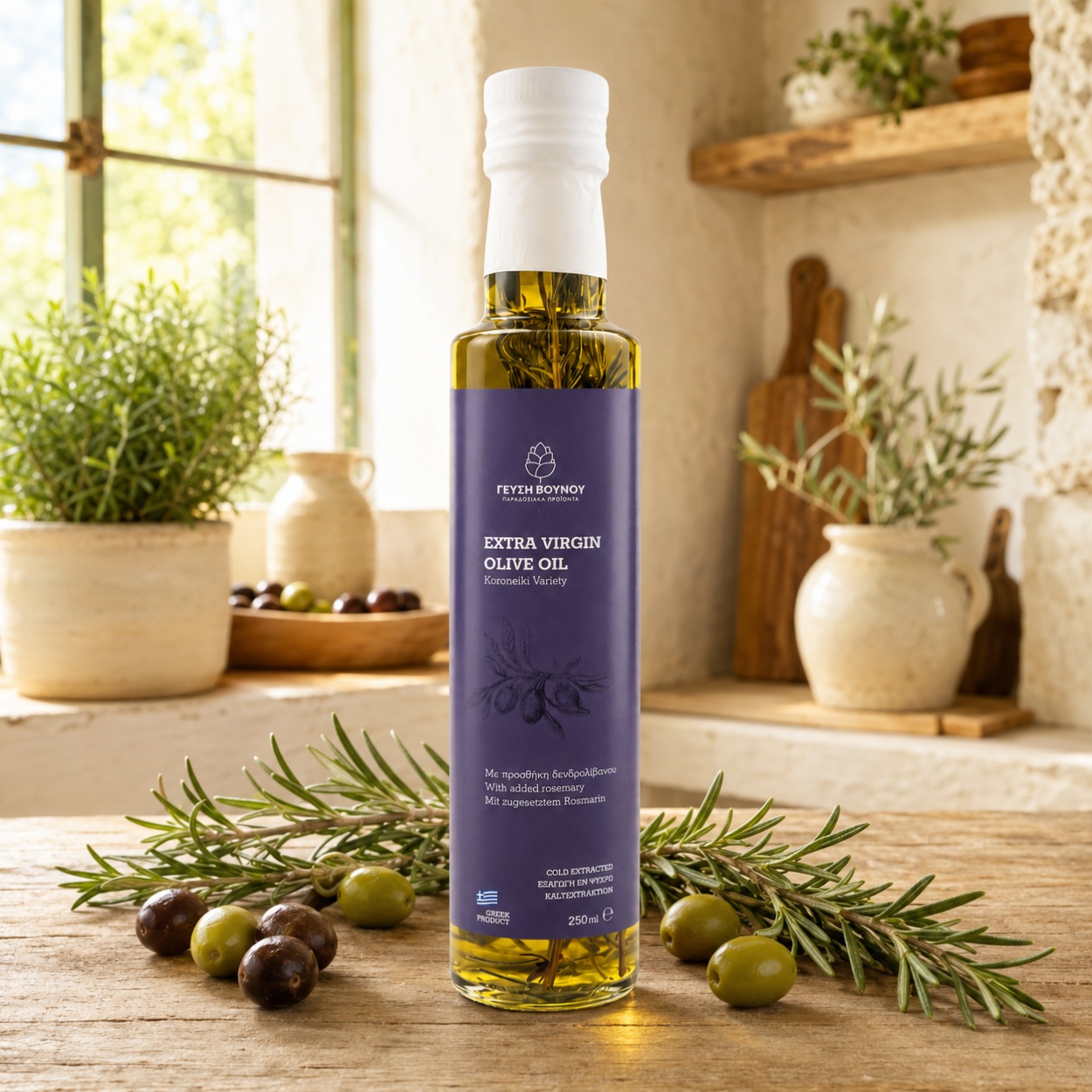
Greek extra virgin olive oil with rosemary, 250 ml very low-acidity olive oil base • rosemary is combined directly with the oil • for potatoes, vegetables, meat and marinades
Geusi Vounou extra virgin olive oil with rosemary has a pronounced herbal profile for roasting, marinades and finishing dishes. The flavoured-oil range is developed in collaboration with other Greek producers. It also works with bread and pulses.
- ● Before roasting • potatoes, root vegetables, meat and fish
- ● To finish • warm salads, pulses and creamy soups
- ● For marinades • pair with lemon, garlic and pepper


Extra virgin olive oil with rosemary (Geusi Vounou, 250 ml)
Geusi Vounou extra virgin olive oil with rosemary combines an olive oil base with the distinctive flavour of this Mediterranean herb. Its rosemary profile works particularly well with ingredients prepared by roasting, grilling or slow braising.
Use the oil with potatoes, root vegetables, courgettes, aubergines, pulses, meat, fish, focaccia and other savoury baked goods. It also works in marinades and as a finishing oil for smooth soups or warm salads.
Before roasting, it coats the ingredients evenly with flavour. When added after cooking, the rosemary aroma remains more pronounced and clearly defined.
How to use
- Potatoes and root vegetables – toss them with the oil, salt and pepper before placing them in the oven.
- Meat and fish – use the oil in a marinade or drizzle it over the finished dish.
- Pulses – add a small amount to lentils, beans or chickpeas when serving.
- Bread – brush it over focaccia, bread or toasted slices before baking or serving.
Rosemary has a pronounced aromatic profile. Start with one teaspoon per serving and add more according to the other ingredients.
Suitable for
Recommended related products
- Organic garlic paste
For roast potatoes, vegetables and marinades. Mix the paste with the rosemary oil and add lemon as needed. - Greek apple cider vinegar
For warm salads and pulse-based dressings. Combine the vinegar with mustard and gradually whisk in the rosemary oil. - Tomato sauce with olives
For pasta, roasted vegetables and savoury tarts. Add the rosemary oil sparingly so it does not overpower the tomatoes and olives.
Did you know?
- Rosemary is commonly paired with potatoes, root vegetables, pulses, meat and savoury baked goods.
- The oil helps carry the rosemary flavour evenly across the surface of roasted or grilled ingredients.
- When added after roasting, the herbal flavour remains more pronounced than during long cooking.
This oil is not organic. Store it away from direct sunlight and sources of heat.
Extra virgin olive oil with rosemary – key benefits
- Extra virgin olive oil – the olive oil base works in both cold and hot dishes.
- Pronounced rosemary profile – the herb flavour is already evenly infused through the oil.
- For roasting – works well with potatoes, root vegetables, courgettes and aubergines.
- With meat and fish – use it in marinades or to finish the cooked dish.
- For pulses – complements lentils, beans, chickpeas and warm pulse salads.
- For savoury breads – use it with focaccia, flatbreads and toasted bread.
- Easy to measure – adjust the intensity according to the ingredients being prepared.
- 250 ml pack – the smaller size is practical for an oil with a pronounced herbal profile.
Rosemary oil works particularly well with roasted, grilled and braised dishes. It complements potatoes, root vegetables, pulses, meat and savoury breads.
Why choose Geusi Vounou
Geusi Vounou is a family farming business from the Grevena region of northern Greece. Its fields lie near the village of Vatolakkos at an altitude of approximately 600 metres, and the brand manages the production, processing and packing of its food under its own name.
The brand’s story follows the legacy of grandmother Magdalini, who passed on the family’s respect for nature, ingredients and traditional preparation. The current generation builds on this experience, combining the family’s agricultural knowledge with modern processing and as little intervention as possible in the natural character of the ingredients.
Geusi Vounou aims to combine Greek flavours with precise standardisation and quality control, bringing regional Greek foods to customers beyond the country. Its production facilities operate under HACCP and ISO 22000 systems; the organic designation applies only to products with the relevant certification.

A family story
The brand builds on the family’s farming experience and the legacy of grandmother Magdalini, rooted in respect for nature and its ingredients.
Origins in the Grevena region
The business is based in northern Greece, with fields near the village of Vatolakkos at an altitude of approximately 600 metres.
Traditional ingredients, modern processing
Geusi Vounou combines Greek agricultural and culinary traditions with modern packing, standardisation and quality control.
Controlled production facilities
Production and processing take place in facilities operating under HACCP and ISO 22000 systems.
Ingredients
Extra virgin olive oil with rosemary.
Store in a cool, dry and dark place, away from direct sunlight and sources of heat. Close the bottle securely after use.
NUTRITIONAL VALUES
| Typical values | per 100 ml | What does this mean for you? |
|---|---|---|
| Energy | 3448 kJ / 824 kcal | A concentrated source of energy typical of olive oils |
| Fat | 91.6 g | Olive oil consists almost entirely of fat |
| of which saturates | 12.8 g | They make up a smaller proportion of the total fat content |
| monounsaturated fatty acids | 72.4 g | They make up the largest share of this olive oil’s fat profile |
| polyunsaturated fatty acids | 6.4 g | They complement its natural fatty acid profile |
| Carbohydrate | 0 g | Oil naturally contains no carbohydrate |
| of which sugars | 0 g | Sugar-free |
| Protein | 0 g | Oil naturally contains no protein |
| Salt | 0 g | Salt-free |
One typical serving (approx. 15 ml / 1 tablespoon) provides approximately 124 kcal and contains around 13.7 g of fat.
FAQ
What is rosemary olive oil?
It is extra virgin olive oil flavoured with rosemary, for roasting, marinating and finishing cooked dishes.

How does the oil taste?
The olive oil flavour is complemented by rosemary’s pronounced herbal and lightly resinous profile.
Which dishes does it work with?
It works well with potatoes, root vegetables, meat, fish, pulses, focaccia and other savoury baked goods.
Can it be used for roast potatoes?
Yes. Toss the potatoes with the oil, salt and, if preferred, pepper or garlic before roasting.
Does it work with meat?
Yes. Use the oil in a marinade or to finish grilled and roasted meat.
Can it be used with fish?
Yes. Use it sparingly and combine it with lemon, salt and milder seasonings.
Can the oil be heated?
Yes, for everyday roasting and cooking. Keep the rosemary aroma more pronounced by adding some of the oil only when serving.
How much oil should I use?
Start with one teaspoon per serving. For marinades, adjust the amount to the volume and surface area of the ingredients being prepared.
Is the oil organic?
No. This flavoured olive oil is not organic.
How should the oil be stored?
Keep it tightly closed in a cool, dark place, away from direct sunlight and sources of heat.
Additional parameters
| Category: | Food |
|---|---|
| EAN: | 5214002734961 |
| Filter by: | Gluten-free |
| Country of origin: | Greece |
| Manufactured by: | Geusi Vounou, Βατόλακκος, Grevená, Greece |
| Vhodné pro: | Bez lepku-GMO Free-Bio |
| Size: | 250 ml |
Product rating
Be the first who will post an article to this item!
Discussion
Be the first who will post an article to this item!
Geusi Vounou – “taste of the mountains” from Grevena, Greece
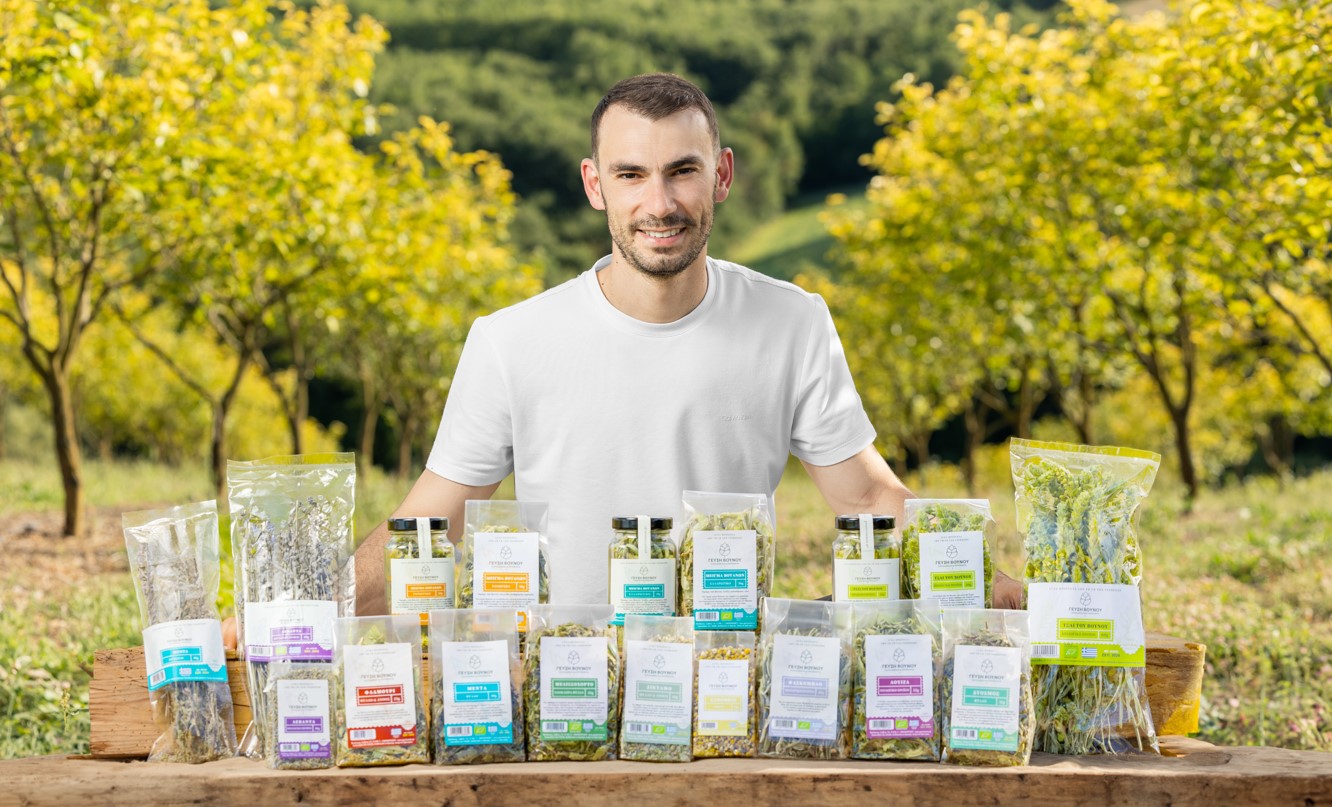
Geusi Vounou (Greek: Γεύση Βουνού, literally “taste of the mountains”) is a family agricultural business from Vatolakkos near Grevena in northern Greece. The brand is run by Vasilis Karapas, an agronomist from a farming family who planted his first oregano on family land in 2014 while still studying. He later added Greek mountain tea, thyme, sage, saffron, lemon balm, other aromatic plants and pulses.
His grandmother Magdalini was an important influence, teaching the family how to work with local herbs and emphasising the value of traditional plant material. What began as a small student project developed into an agricultural brand combining Greek farming and culinary traditions with modern processing control, packing and export.
.jpg)
Not an anonymous brand. A real farm in Western Macedonia.
- Fields near Vatolakkos at approximately 600 m above sea level – not 680 m, as our website previously stated incorrectly.
- A family farming tradition – Vasilis grew up working in the fields and built on the experience of previous generations.
- Farm-grown herbs are naturally shade-dried to avoid unnecessary loss of aroma during drying.
- Herbs and pulses form the core of the farm’s own production. We use organic claims only for products that are individually certified; the brand’s wider range is not automatically organic.
Greek agricultural press reported in 2023 that the family farm covered approximately 50 hectares, including around 20 hectares of pulses and about 14 hectares of aromatic plants. Cereals used in crop rotation also remained part of the farming system. For the pulses and aromatic crops, the source reported certified organic cultivation.
Why Greek herbs are more than “just another oregano”
With Geusi Vounou, the main difference is not decorative packaging but provenance and the way the raw material is handled. Vasilis describes manual work from planting and weeding through harvesting, drying and packing. With aromatic plants, the aim is to preserve the character of the whole plant with as little processing as possible before packing.
For customers outside Greece, it is also useful to understand what individual Greek ingredients actually are and how they are used. A literal translation of the name is not always enough. Greek mountain tea, dittany, trahanas, kritharaki, hilopitaki and petoura are not marketing terms; they are specific traditional herbs, foods or types of pasta with their own uses.
From herbs and pulses to the wider Greek pantry
Today’s Geusi Vounou range is broader than the farm’s original production. At PraveBio.cz we therefore distinguish between two parts of the assortment:
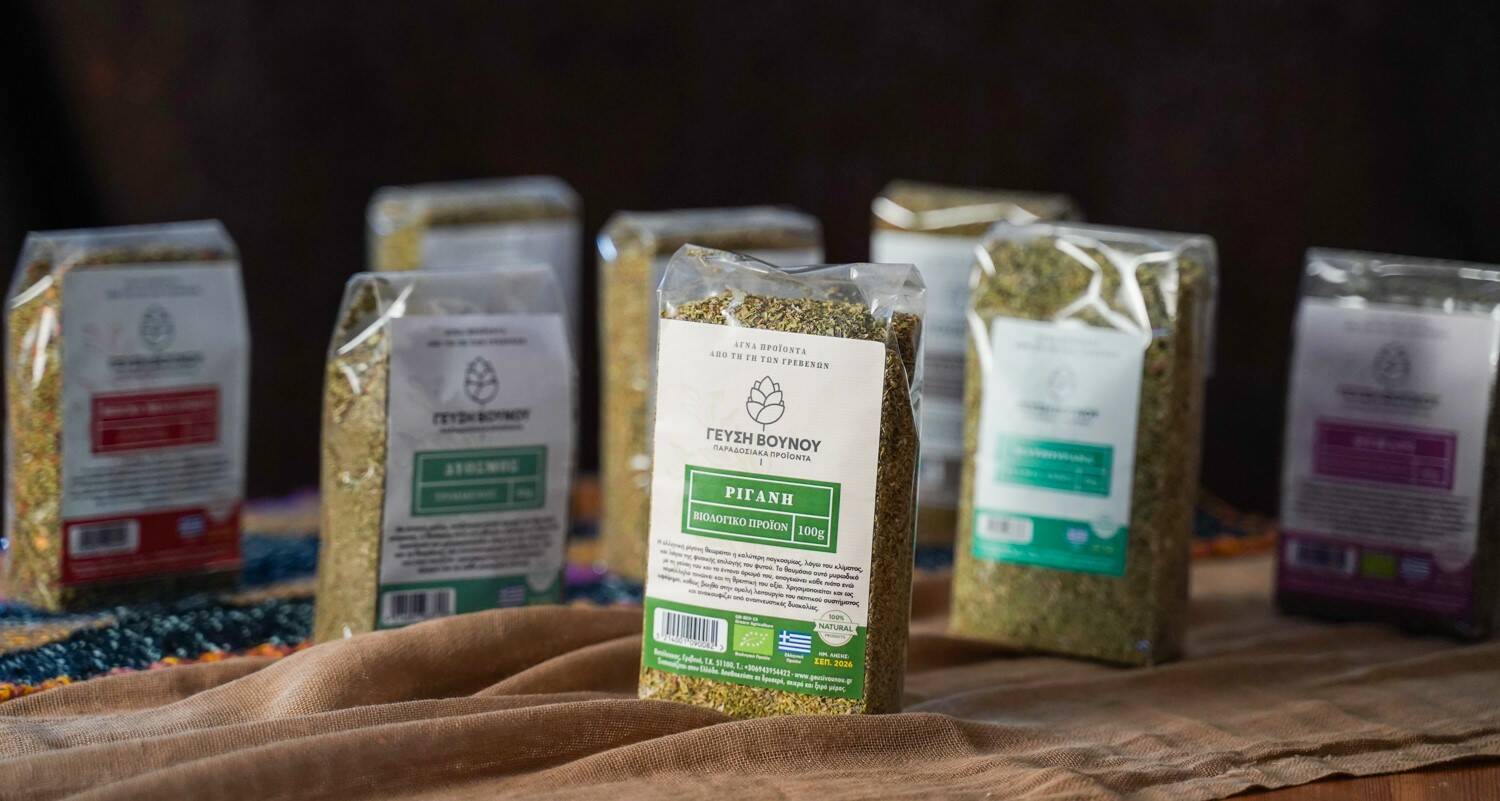
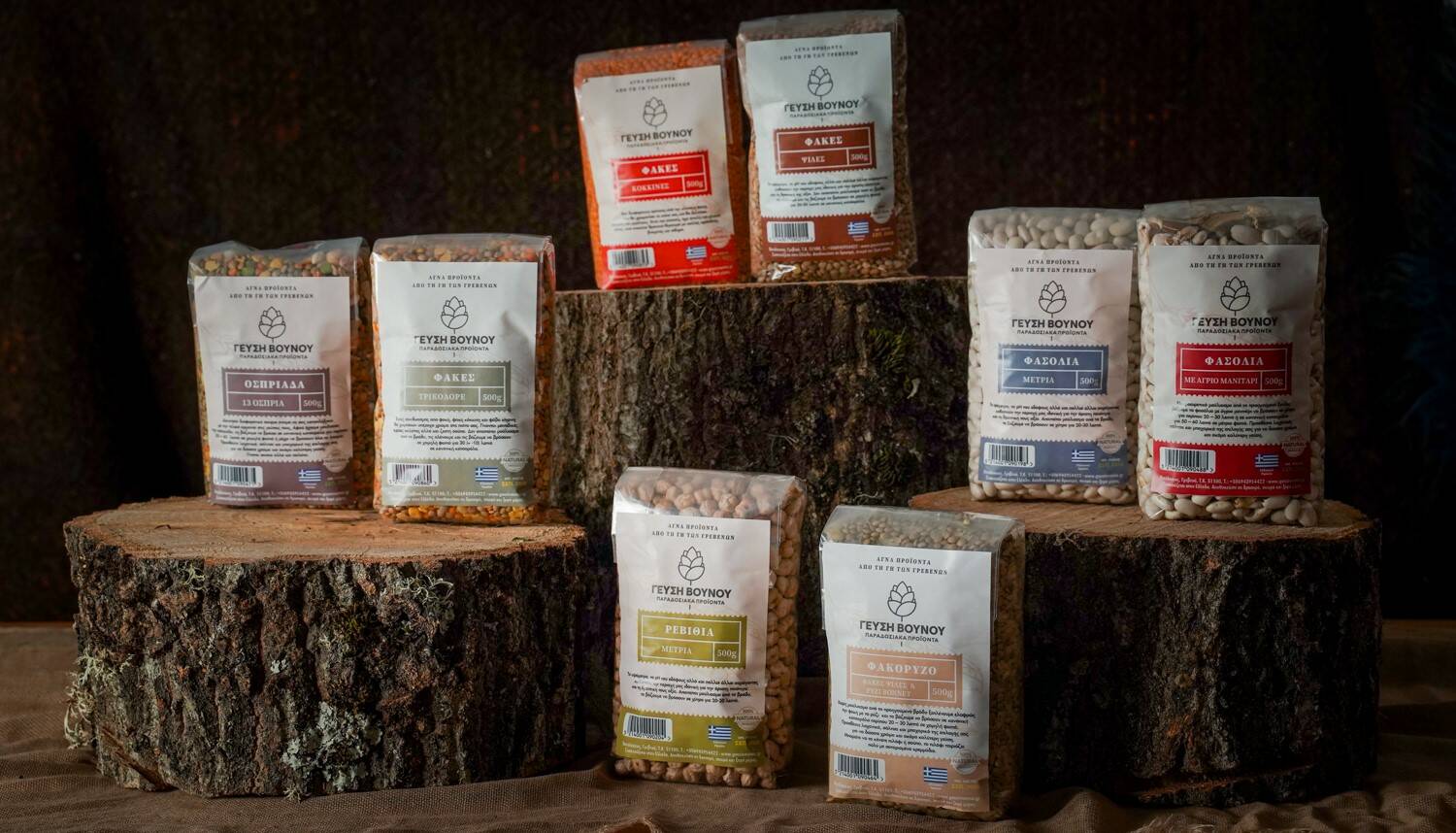
- The farm-grown core: oregano, thyme, sage, lemon balm, Greek mountain tea, saffron, other herbs and pulses.
- The wider Greek range: traditional pasta, honey, mushrooms and truffle products, flavoured olive oils and other regional foods.
For each product we therefore check origin, ingredients, organic certification, the traditional name and the correct way to use it. The aim is not to sell customers “something Greek” without context, but to explain what makes each ingredient different, how to prepare it and why it has a place in Greek cooking.
Vasilis Karapas: from the first oregano crop to an export brand
Vasilis Karapas was born in Grevena in 1994 and studied agricultural development and farm business management in Thessaloniki. He has worked professionally in agricultural production and packing since 2014. Oregano was the first crop, followed by other aromatic plants and pulses.
Greek media reported in 2024 that more than 70% of production was exported. Exports began in Germany in 2018 and later expanded to other European countries, including the Czech Republic. Geusi Vounou was not created as a souvenir brand for tourists; it grew out of a working agricultural business and now sells its products across several markets.
Geusi Vounou at PraveBio.cz
PraveBio distributes Geusi Vounou in the Czech Republic and Slovakia. As with Ceylon Kokonati, we explain the differences between individual products, their Greek names, how they are used in the kitchen and the genuine USPs of each ingredient. Organic claims are used only where they apply to the specific certified product.