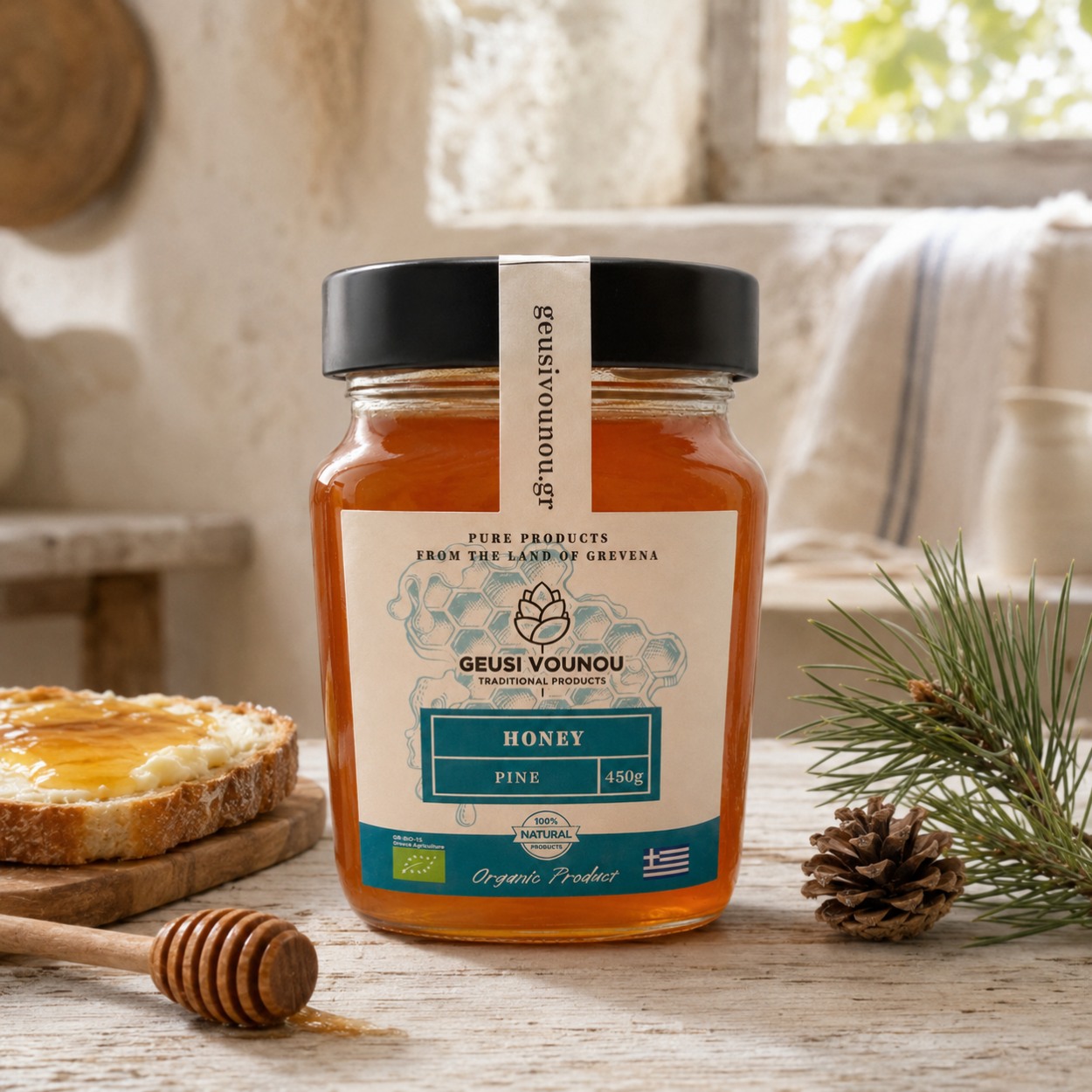
Organic Greek pine honeydew honey – 450 g dark honeydew honey • fuller, less floral flavour with woodland notes • for cheese, nuts and sweet-savoury sauces
Geusi Vounou Organic Pine Honey is a darker honeydew honey from Greek pine forests, with a fuller, less floral flavour and a woodland aroma. It works well on bread and pastries, in porridge and yoghurt, with mature cheeses and nuts, or in sweet-and-sour sauces.
Compared with mild blossom honey, it pairs better with stronger ingredients such as mustard, vinegar, spices and dark bread. The 450 g pack is suited to regular table use, baking and preparing marinades.
Why we added Geusi Vounou to the PraveBio.cz range
Geusi Vounou is a Greek agricultural business from the Grevena region that produces, processes and packs food under its own brand. Its range includes herbs, spices, pulses, honey, mushrooms, olive oils and traditional pasta.
We added the brand to the PraveBio.cz range for its traceable regional origin, direct links to agricultural production and clear labelling of certified organic products.


Pine honey (Geusi Vounou, 450 g)
Geusi Vounou Organic Pine Honey is a Greek honeydew honey made from honeydew found in pine forests. It has a darker colour, a smooth to thicker consistency and a fuller woodland flavour with milder sweetness than many blossom honeys.
Its less floral profile pairs well with dark bread, yoghurt, porridge, nuts, hard cheeses, baked fruit and spiced desserts. Its flavour remains noticeable alongside stronger ingredients.
In savoury cooking, use it in marinades, glazes and salad dressings. Combining the honey with vinegar, mustard, lemon juice or seasoning creates a balanced sweet-and-sour base.
How to use
- Bread and breakfast – add it to bread, yoghurt, quark or porridge, or drizzle it over fruit and nuts.
- Cheese – serve it with hard, mature, sheep’s or goat’s cheeses.
- Baking – use it in gingerbread, biscuits, fruit pies and spiced doughs.
- Marinades and glazes – mix it with vinegar, mustard, citrus juice, oil and seasoning.
For cold sauces, first blend it into the acidic ingredient, then add the oil gradually. When sweetening drinks, stir in the honey once the drink has partly cooled.
Suitable for
Recommended related products
- Organic whole wheat bran flakes
For a grain-based breakfast with a more pronounced honey. Add the pine honey to the finished serving with yoghurt and nuts. - Bragg Organic Apple Cider Vinegar
For marinades and salad dressings. The fuller pine honey balances the vinegar’s acidity and combines well with mustard and seasoning. - Unsulphured Light Sultana Raisins
For porridge, baking and cheese pairings. The fruity flavour of the raisins softens the darker woodland profile of the pine honey.
Did you know?
- Pine honey is a honeydew honey. Its character therefore does not come primarily from the nectar of pine flowers.
- Compared with light blossom honeys, it tends to have a darker colour, fuller flavour and less floral aroma.
The official Geusi Vounou range lists the product as organic.
Pine honey – main benefits
- Honeydew origin – the honey is made from honeydew found in pine forests rather than primarily from floral nectar.
- Darker colour – its appearance differs from light multifloral and acacia honeys.
- Fuller woodland flavour – pairs well with dark bread, porridge, yoghurt, cheese and nuts.
- Less floral profile – its flavour remains more noticeable alongside spices, mustard, vinegar and other stronger ingredients.
- Sweet and savoury cooking – use it in desserts, baking, dressings, marinades and glazes.
- Pairs well with mature cheeses – its sweetness complements salty, pronounced cheese flavours.
- Certified organic status – this honey is listed as organic in the official range.
- 450 g pack – the size suits everyday use at breakfast, in baking and cooking.
Pine honey suits customers who prefer darker honeydew honeys with a fuller, less floral flavour. It works well on its own and alongside pronounced savoury ingredients.
Why Choose Geusi Vounou
Geusi Vounou is a family-run farming business from the Grevena region in northern Greece. Its fields are located near the village of Vatolakkos, at an altitude of around 600 metres, and the brand manages the production, processing and packaging of food under its own name.
The story of the brand is rooted in the legacy of grandmother Magdalini, who passed on to the family a respect for nature, raw ingredients and traditional ways of preparing them. The current generation builds on this experience, combining the family’s farming knowledge with modern processing and minimal intervention in the natural character of the ingredients.
Geusi Vounou’s vision is to connect Greek flavours with precise standardisation and quality control, and to introduce regional Greek foods to customers beyond the country’s borders. The production facilities operate according to HACCP and ISO 22000 systems; organic labelling applies only to specifically certified products.

Family Story
The brand builds on the family’s farming experience and the legacy of grandmother Magdalini, founded on respect for nature and its raw ingredients.
Origin in the Grevena Region
The business is based in northern Greece and its fields are located near the village of Vatolakkos, at an altitude of around 600 metres.
Traditional Ingredients, Modern Processing
Geusi Vounou connects Greek farming and culinary traditions with modern packaging, standardisation and quality control.
Controlled Production Facilities
Production and processing take place in facilities operating according to HACCP and ISO 22000 systems.
Ingredients
Organic pine honey.
Store in a dry, dark place at normal room temperature, away from direct sunlight and sources of heat. Honey is not suitable for babies under 12 months.
FAQ
What is pine honey?
Pine honey is a honeydew honey made from honeydew found in pine forests. It does not come primarily from floral nectar.

What does pine honey taste like?
It has a fuller, less floral flavour with mild sweetness and a woodland character. The particular notes may naturally vary between harvests.
What colour is it?
The product information describes it as a darker honey. The exact shade may vary between harvests.
How does it differ from blossom honey?
Blossom honey is made from floral nectar and tends to have a more floral character. Pine honey is a darker honeydew honey with a flavour more reminiscent of woodland ingredients.
How can pine honey be used?
Use it on bread, in yoghurt, quark and porridge, with nuts and mature cheeses, or in baking, dressings, marinades and glazes.
Can it be used in marinades?
Yes. It combines well with vinegar, lemon juice, mustard, olive oil, garlic and seasoning.
Does it pair well with cheese?
Yes. Its fuller woodland flavour pairs well with hard, mature, sheep’s and goat’s cheeses.
Is this pine honey organic?
Yes. The official Geusi Vounou range lists this honey as organic.
Can pine honey crystallise?
Yes, its consistency may change during storage. The rate of change depends on the natural composition of the particular harvest and the temperature.
Is honey suitable for kids?
Honey is not suitable for babies under 12 months. For older kids, use it as a standard sweet food.
Additional parameters
| Category: | Food |
|---|---|
| EAN: | 5214003092251 |
| Key Feature: | Single-ingredient, Whole-food based |
| Filter by: | Gluten-free |
| Country of origin: | Greece |
| Manufactured by: | Geusi Vounou, Βατόλακκος, Grevená, Greece |
| Vhodné pro: | Gluten free-GMO Free |
| Size: | 450 g |
Product rating
Be the first who will post an article to this item!
Discussion
Be the first who will post an article to this item!
Geusi Vounou – “taste of the mountains” from Grevena, Greece
Geusi Vounou (Greek: Γεύση Βουνού, literally “taste of the mountains”) is a family agricultural business from Vatolakkos near Grevena in northern Greece. The brand is run by Vasilis Karapas, an agronomist from a farming family who planted his first oregano on family land in 2014 while still studying. He later added Greek mountain tea, thyme, sage, saffron, lemon balm, other aromatic plants and pulses.
His grandmother Magdalini was an important influence, teaching the family how to work with local herbs and emphasising the value of traditional plant material. What began as a small student project developed into an agricultural brand combining Greek farming and culinary traditions with modern processing control, packing and export.
.jpg)
Not an anonymous brand. A real farm in Western Macedonia.
- Fields near Vatolakkos at approximately 600 m above sea level – not 680 m, as our website previously stated incorrectly.
- A family farming tradition – Vasilis grew up working in the fields and built on the experience of previous generations.
- Farm-grown herbs are naturally shade-dried to avoid unnecessary loss of aroma during drying.
- Herbs and pulses form the core of the farm’s own production. We use organic claims only for products that are individually certified; the brand’s wider range is not automatically organic.
Greek agricultural press reported in 2023 that the family farm covered approximately 50 hectares, including around 20 hectares of pulses and about 14 hectares of aromatic plants. Cereals used in crop rotation also remained part of the farming system. For the pulses and aromatic crops, the source reported certified organic cultivation.
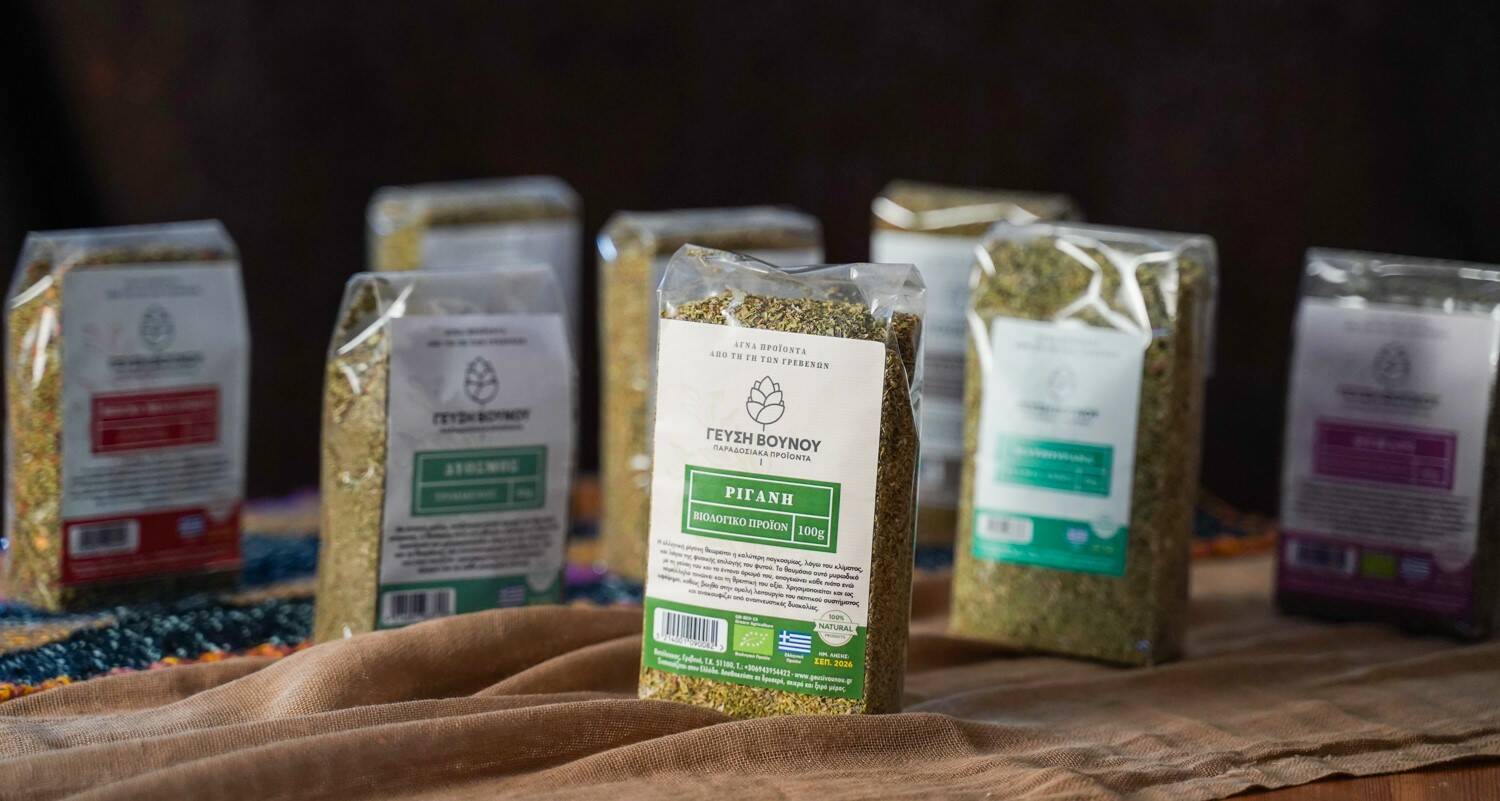
Why Greek herbs are more than “just another oregano”
With Geusi Vounou, the main difference is not decorative packaging but provenance and the way the raw material is handled. Vasilis describes manual work from planting and weeding through harvesting, drying and packing. With aromatic plants, the aim is to preserve the character of the whole plant with as little processing as possible before packing.
For customers outside Greece, it is also useful to understand what individual Greek ingredients actually are and how they are used. A literal translation of the name is not always enough. Greek mountain tea, dittany, trahanas, kritharaki, hilopitaki and petoura are not marketing terms; they are specific traditional herbs, foods or types of pasta with their own uses.
From herbs and pulses to the wider Greek pantry
Today’s Geusi Vounou range is broader than the farm’s original production. At PraveBio.cz we therefore distinguish between two parts of the assortment:
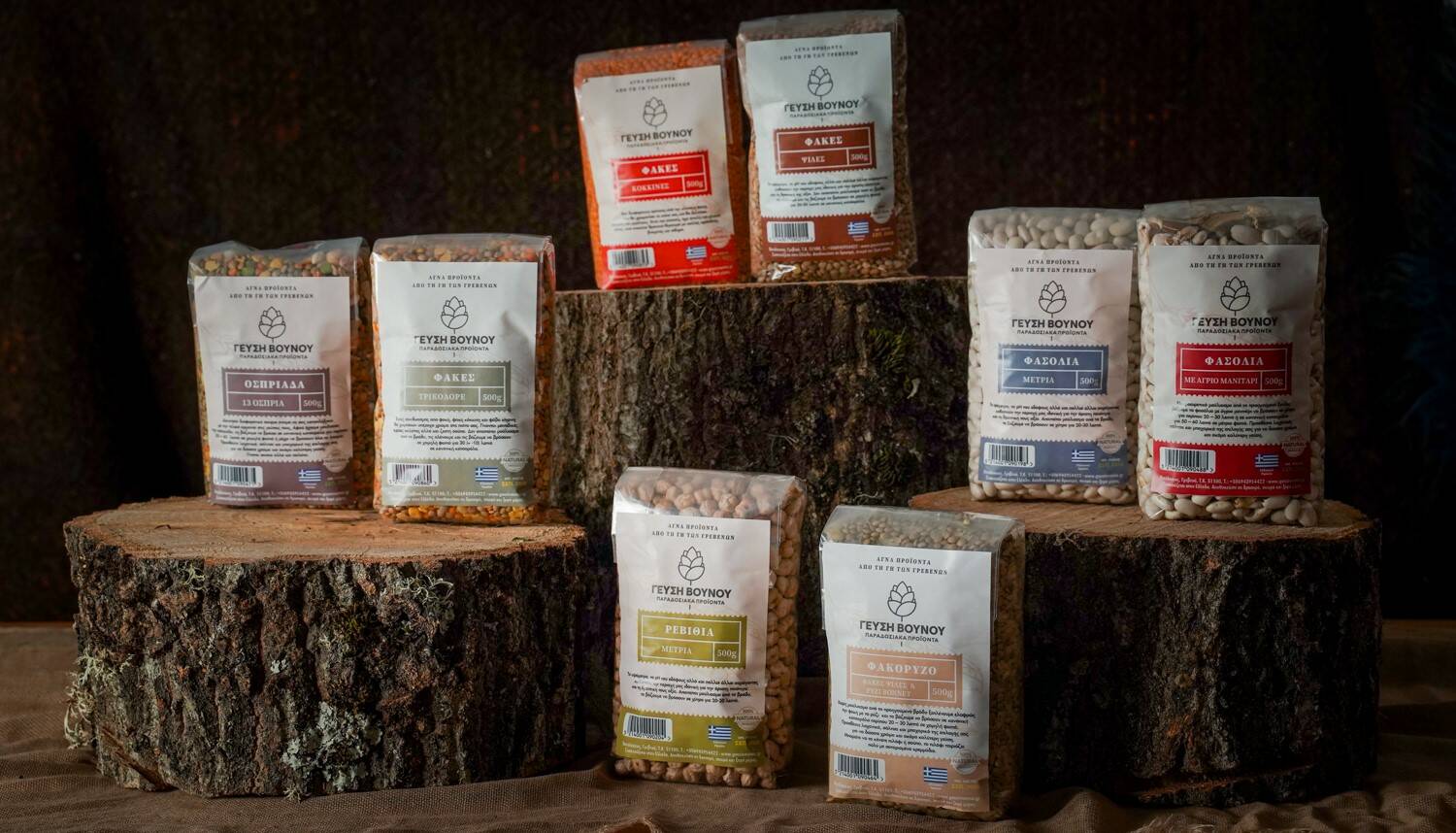
- The farm-grown core: oregano, thyme, sage, lemon balm, Greek mountain tea, saffron, other herbs and pulses.
- The wider Greek range: traditional pasta, honey, mushrooms and truffle products, flavoured olive oils and other regional foods.
For each product we therefore check origin, ingredients, organic certification, the traditional name and the correct way to use it. The aim is not to sell customers “something Greek” without context, but to explain what makes each ingredient different, how to prepare it and why it has a place in Greek cooking.
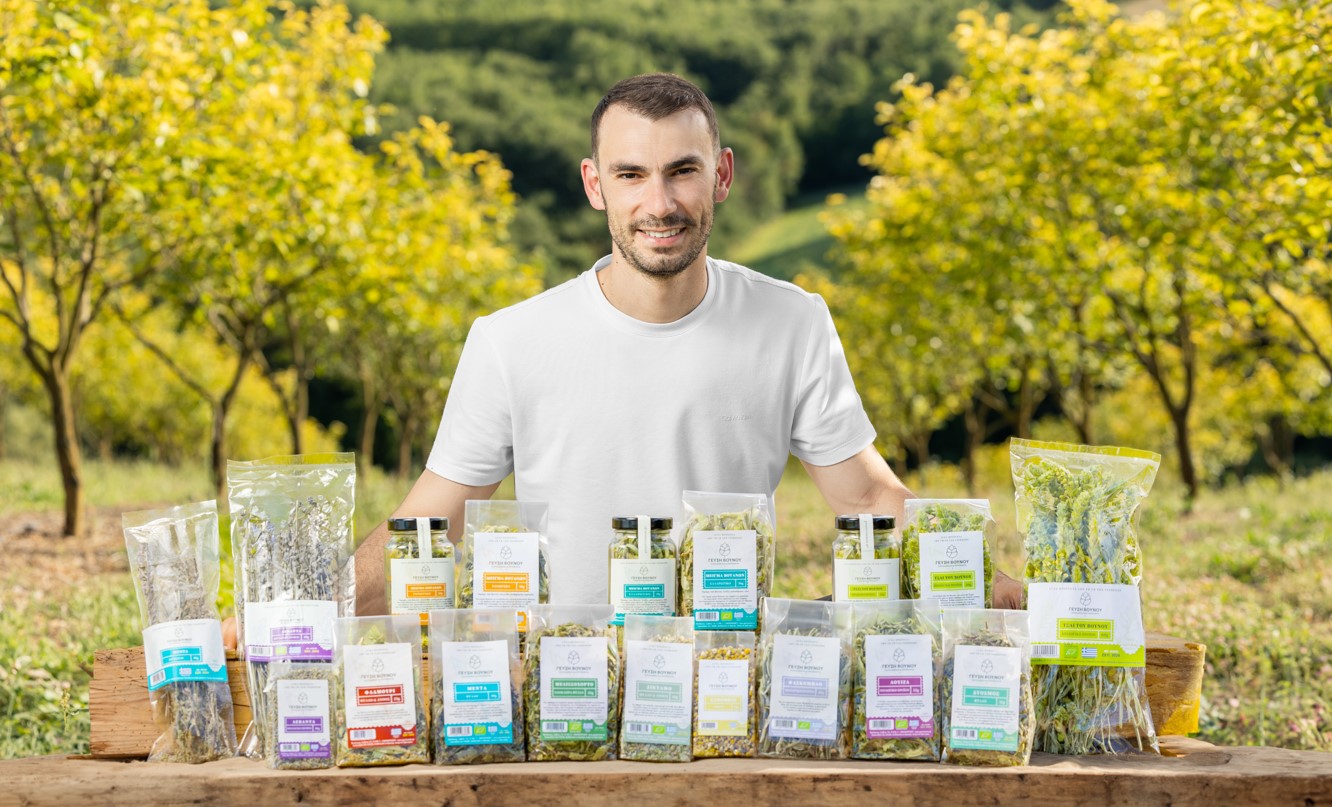
Vasilis Karapas: from the first oregano crop to an export brand
Vasilis Karapas was born in Grevena in 1994 and studied agricultural development and farm business management in Thessaloniki. He has worked professionally in agricultural production and packing since 2014. Oregano was the first crop, followed by other aromatic plants and pulses.
Greek media reported in 2024 that more than 70% of production was exported. Exports began in Germany in 2018 and later expanded to other European countries, including the Czech Republic. Geusi Vounou was not created as a souvenir brand for tourists; it grew out of a working agricultural business and now sells its products across several markets.
Geusi Vounou at PraveBio.cz
PraveBio distributes Geusi Vounou in the Czech Republic and Slovakia. As with Ceylon Kokonati, we explain the differences between individual products, their Greek names, how they are used in the kitchen and the genuine USPs of each ingredient. Organic claims are used only where they apply to the specific certified product.