Natural Dental Care: How to Achieve a Healthy, Radiant Smile Without Chemicals or Guilt
A bright smile is part of how each of us is seen. But it’s not just about looks – healthy teeth underpin everyday comfort, confidence and quality of life. Still, many of us hesitate when choosing oral care: is it better to use a standard toothpaste with fluoride, or a natural toothpaste without unnecessary additives? The sooner we learn to care for our teeth in a more natural, mindful way, the better.
I received the brief for this article a few days before my preventive dental check-up and dental hygiene appointment. I couldn’t resist – so I used the opportunity to ask a few questions on the topic.
In this article, we’ll look at how to care for your teeth without guilt – with respect for nature, your own values and the needs of different age groups. We’ll explain what cariogenicity is, how fluorides work, and what the alternatives are. And we’ll also introduce Georganics – a leader in natural oral care.

Contents
What should be part of your daily oral care?
Basic oral hygiene is key to healthy teeth and helps with the prevention of tooth decay and gum inflammation. We should care for our teeth in the morning after breakfast and at night before bed. What should daily dental care include?
- Interdental brushes and/or dental floss – to remove food debris and dental plaque between teeth.
- Brushing with gentle circular movements, ideally with a soft toothbrush.
- Single-tuft brush – effectively removes plaque in areas where the tooth meets the gumline. This helps reduce the risk of gum inflammation and periodontitis.
- Tongue cleaning – because bacteria settle on its surface and can cause bad breath.
- Mouthwash (including natural options) – reduces the amount of bacteria in the mouth and freshens breath.
Don’t forget a suitable diet too:
- Rinsing your mouth regularly with unsweetened water, especially after eating.
- Enough fibre – ideally from whole fruit and vegetables, where chewing naturally cleans teeth, supports saliva production and strengthens chewing muscles.
- Limiting sugar, which is cariogenic and supports the development of tooth decay.
Cariogenicity: What harms teeth and how to protect them
Cariogenicity means the ability of food or drink to promote tooth decay. The biggest culprits are sugars (sucrose) and acids – favoured by bacteria in the mouth, which turn them into an aggressive environment that weakens tooth enamel.
The most common cariogenic factors:
- Sweet fizzy drinks and juices.
- Biscuits, sweets and confectionery.
- Frequent snacking throughout the day (without enough time for saliva to neutralise acids).
- Insufficient oral hygiene after eating.
How can you protect your teeth from decay?
- Cut back on sweets and eat at regular intervals.
- After eating, have some water or sugar-free chewing gum without artificial sweeteners.
- Saliva is your teeth’s natural defence – support its production with a good drinking routine and chewing fibrous foods.1
Abrasivity and teeth whitening: What’s safe and what can do harm?
Toothpaste abrasivity indicates how strongly it mechanically wears the tooth surface – the enamel. It’s measured using the RDA value (Relative Dentin Abrasivity). Low RDA (up to 70) is suitable for sensitive teeth and everyday use, while toothpastes with higher abrasivity (100 and above) tend to be better for occasional use or whitening. With excessive use of abrasive toothpastes, powders or home methods (e.g. bicarbonate of soda, activated charcoal), there is a risk of thinning enamel, sensitivity and a higher risk of tooth decay.
Whitening toothpastes usually only remove surface staining rather than truly whiten teeth. A genuine lightening of the tooth shade can only be achieved with professional whitening at the dentist or dental hygienist – using peroxide gels that penetrate the tooth structure. These methods are effective and safe when carried out by a professional. By contrast, at-home whitening without supervision can lead to gum irritation and damage to tooth tissue.
Tip: For regular use, choose low-abrasive toothpastes, alternate between gentler and whitening products, and always consult a professional about whitening – especially if you have sensitive teeth or fillings.2
Fluoride in toothpaste: Yes or no?
Fluoride is a mineral that occurs naturally in nature and has been used in toothpastes for decades. It helps strengthen tooth enamel and reduce the risk of tooth decay. According to my dental hygienist, definitely yes – but… Scientific studies confirm its effectiveness, while also raising questions about long-term use, especially in children and when combined with other sources of fluoride.
Benefits of fluoride:
- Strengthens enamel and slows demineralisation.
- Helps remineralise early-stage tooth decay.
- Reduces bacterial activity in the mouth.
Risks of excessive fluoride intake:
- Possible fluorosis (white spots on teeth, mainly in children).
- Potential toxic effects at high doses.
- Accumulation in the body with long-term intake from multiple sources.
Fluoride in food and water – hidden intake
Fluorides occur naturally in some foods and drinks, for example:
- black tea,
- sea fish,
- drinking water from some water supplies,
- fluoridated salt.
This means that even if we don’t use fluoride toothpaste, we may still take in fluoride from other sources every day – which is important to consider when choosing oral care for children.3,4
Oral care by age: How to look after teeth from babies to seniors
Each stage of life calls for a different approach to oral care and sets you up for what comes next. From first teeth to dentures – let’s look at what to consider at different times of life.
Babies and first teeth (0–2 years)
- Use a silicone brush to gently clean gums and first teeth.
- Keep an eye on teething and limit sweet drinks.
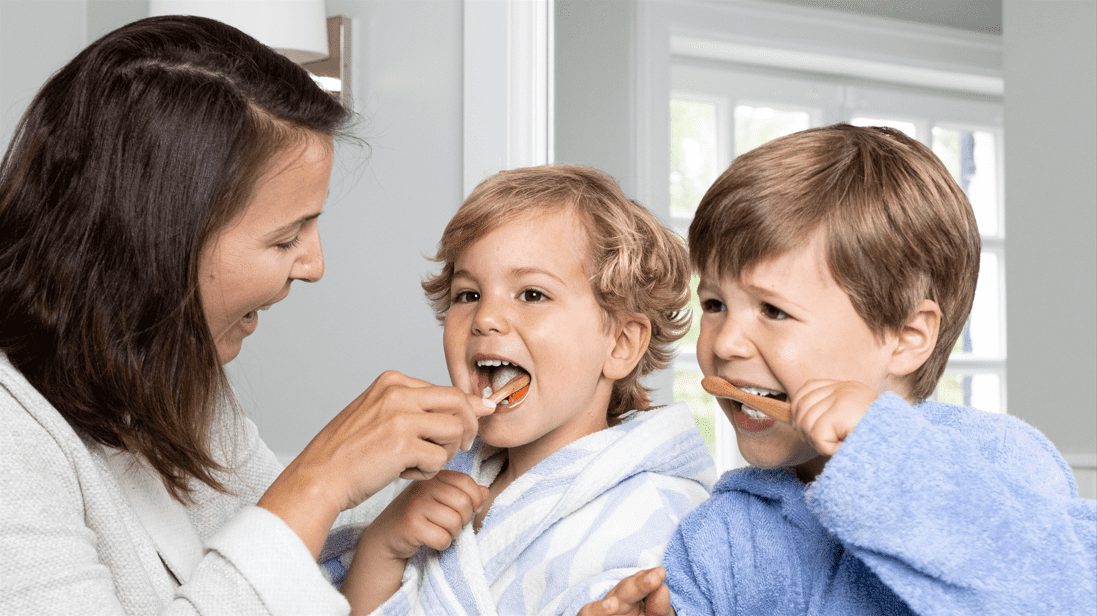
- Build the habit of brushing little teeth – ideally in a playful way: songs, rhymes, books, and brushing together with parents.
- Let your child try it on their own, but stay with them.
- First dental visit? Ideally after the first teeth come through – take your child with you so they get used to the environment.
Children (3–12 years)
- Building habits is key – teach children that brushing teeth is a daily part of the day.
- Use a children’s toothbrush and toothpaste with an age-appropriate amount of fluoride (or a natural fluoride-free option).
- Help with brushing until around age 8, when they often still don’t have the technique right.
- Don’t forget preventive dental check-ups, ideally paired with something enjoyable (a play area, a trip out). This year, after the dentist we went on the fairground rides.
Teenagers and adults
- Focus on gum care, prevention of tooth decay and regular dental hygiene appointments.
- Some people choose natural teeth whitening, for example using activated charcoal (consider abrasivity and your teeth’s sensitivity).
- Pay attention to how diet, stress and hormonal changes can affect oral health.
Seniors
- There is often a need for extra gum care and support for sensitive teeth.
- More frequent tartar build-up, gum recession (a single-tuft brush is important) and tooth wear.
- Consistent care of dentures, implants and overall periodontal health is key.
Oral care without (or with) fluoride: A natural alternative with respect for nature
Natural oral care is becoming increasingly popular. More and more people are avoiding synthetic ingredients, SLS (sodium lauryl sulphate) and especially fluoride, which some people worry about because of potential side effects. And this is where the brand Georganics comes in – a pioneer in natural oral hygiene, with a strong focus on effectiveness, ecology and health. You can choose the option that suits you best.
Georganics: Modern natural oral care
This brand comes from the United Kingdom and was created with a clear aim – to offer an effective alternative to conventional toothpastes full of unnecessary additives and plastic waste. Georganics products contain no synthetic colourants or preservatives and come in zero-waste packaging. Customers can choose between variants that do not contain fluoride and those that do.
Natural ingredients and what they’re used for
- Xylitol – a natural sweetener that helps reduce the amount of bacteria in the mouth.
- Activated charcoal – helps lift surface staining and supports a cleaner feel.
- Bentonite clay – supports cleansing of the mouth and natural remineralisation of teeth.
- Coconut oil – known for its antibacterial properties, suitable for oil pulling.
Key benefits of natural oral care with Georganics
- Variants without fluoride – no risk of fluorosis or excessive fluoride build-up.
- Ethical formulation – vegan, cruelty-free, non-GMO and no animal testing.
- Eco-friendly packaging – a zero-waste approach with minimal impact on the planet.
- Free from heavy metals and ingredients harmful to health - the products comply with Regulation (EC) No 1223/2009 on cosmetic products and meet UK Cosmetics Regulation. Each product has a prepared Cosmetic Product Safety Report (CPSR). The company also closely monitors supplier quality, so that no raw material presents a health risk.
Possible limitations
- A less aggressive approach to enamel – in cases of active tooth decay, it can be appropriate to combine it with professional care.
- For young children, it may be best to add regular dental check-ups and, if recommended by a professional, choose a toothpaste with a gentle fluoride content.
What does Georganics offer?
The brand Georganics specialises in natural oral care, with options without fluoride, and its range is designed to be kind to your body and the planet. It’s an ideal choice for anyone looking for an ethical, vegan and zero-waste alternative to standard toothpastes and mouthwashes.
Main Georganics products:
- Fluoride-free toothpastes – containing coconut oil, activated charcoal and essential oils (e.g. mint or tea tree).
- Toothpaste tablets – ideal for travel, without the need for water and without plastic tubes.
- Oil pulling mouth oils – inspired by Ayurvedic tradition, supporting gum care and a clean-feeling mouth.
- Zero-waste packaging – glass jars, recyclable labels, compostable brushes and reduced plastic use.
Who is Georganics for?
For anyone who wants to care for their teeth naturally, without unnecessary additives and with consideration for the environment. The brand offers simple, functional solutions for a more sustainable lifestyle without guilt.5
Natural oral care: a small step for you, a big one for the planet
Oral care is not only about cleanliness, but also about a more conscious relationship with health, nature and your own body. Whether you use a fluoride toothpaste or you’re looking for natural oral care without unnecessary additives, what matters most is consistency, proper technique and making informed choices.
Georganics shows that a bright smile can go hand in hand with an ethical approach, a zero-waste lifestyle and a safe formulation. Without fluoride, without plastic waste – just clean, effective and gentle care.
Join those who want more for themselves and for the world.
Change starts in the bathroom. And it can start today.
Did you find the article useful? Share it with your friends using the button below. If you don’t want to miss more interesting updates, subscribe to our news and follow us on social media.
Under EU regulations, we cannot link from the blog to pages with promoted products. You can, of course, find the products on our website Pravé Bio.
Sources
- Sucrose promotes caries progression by disrupting the microecological balance in oral biofilms: an in vitro study. (2020). Scientific Reports. Source here.
- Effect of Whitening Toothpastes with Different Active Agents on the Abrasive Wear of Dentin Following Tooth Brushing Simulation. (2024). Journal of Functional Biomaterials. Source here.
- Fluoride toothpastes of different concentrations for preventing dental caries. (2019). Cochrane database of systematic reviews. Source here.
- Topical fluoride as a cause of dental fluorosis in children. (2024). The Cochrane database of systematic reviews. Source here.
- Georganics official website. Source here.
ŠárkaShe has devoted her education and professional life to the worlds of gastronomy and nutrition. After studying hospitality and human nutrition, she completed her training with a qualification as a nutrition therapist, which gave her a well-rounded perspective on the connection between food and health.
She now uses this knowledge primarily in caring for her children.
She isn’t afraid of challenges and opportunities, believes in new beginnings and values a sustainable way of life. Outside her profession, she enjoys gardening, hiking and, above all, her family – which remains her strongest anchor.