Probiotics, Synbiotics or Enzymes? What’s the Difference—and What’s Best for Healthy Digestion?
Healthy digestion starts in the gut. When your microbiome is in balance, your body absorbs nutrients more efficiently, and both immunity and mental wellbeing work better. Probiotics, synbiotics, and digestive enzymes can help – three categories that are often confused, even though each works in a different way.
Article contents
Probiotics and synbiotics – live support for gut health
Probiotics are live microorganisms that support the balance of the gut microbiota – and with it, healthy digestion. You’ll find them in yoghurt, kefir, kombucha, and sauerkraut. According to the World Health Organization (WHO), probiotics are “live microorganisms which, when administered in adequate amounts, confer a health benefit on the host”.1
To stay active and resilient, probiotic bacteria need prebiotics – substances (such as inulin or other fibre) that act as their food source. When probiotics and prebiotics are combined, they form synbiotics, often considered the most effective form of natural digestive support.
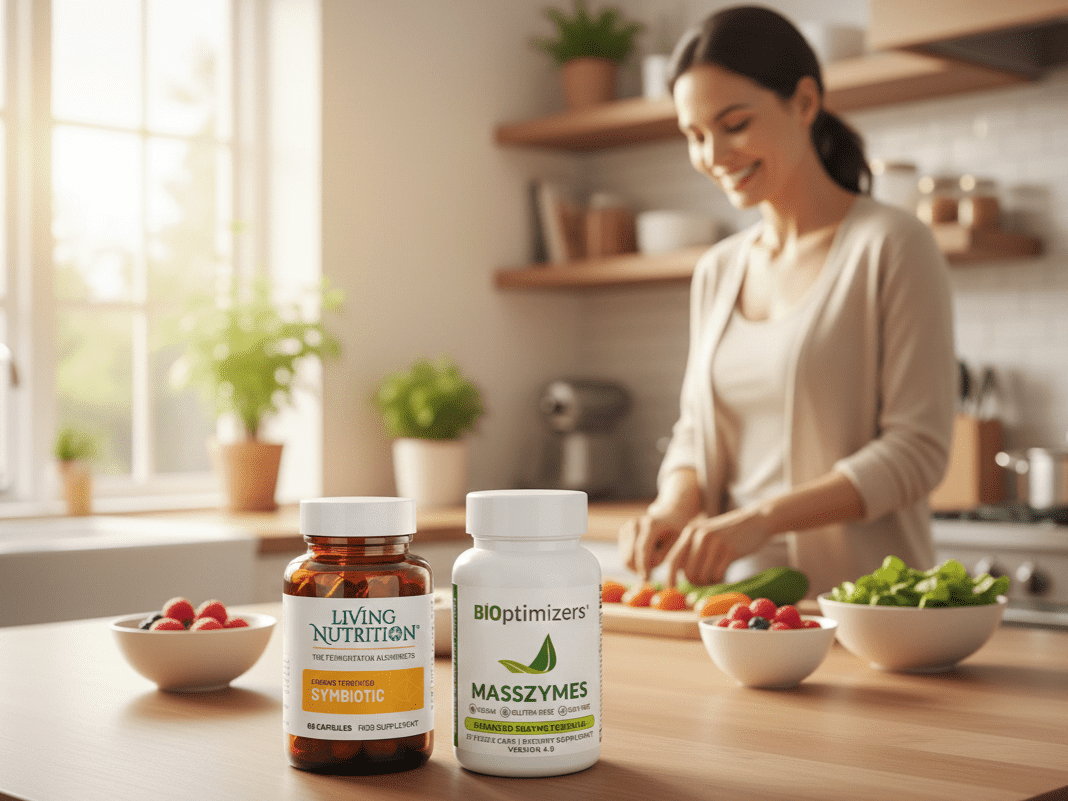
The variability of the gut microbiome is huge. For both microbiome health and overall wellbeing, it’s beneficial to preserve this diversity. Living Nutrition produces fermented dietary supplements made from mushrooms, herbs, as well as a synbiotic range designed to help harmonise digestion. To preserve nutrients, they use freeze-drying – known as lyophilisation. Try Symbiotik, which contains more than 120 strains of beneficial bacteria, delivering at least 30 billion CFU per dose.3
Enzymes – the natural engine of digestion
Unlike probiotics, enzymes are not living organisms. They are proteins that help break down food – carbohydrates, proteins, and fats – into simpler substances your body can absorb.
When the body lacks enzymes (for example due to stress, age, or a limited diet), it may lead to:
- bloating,
- a heavy feeling after meals,
- fatigue.
Supplementing them can help restore natural digestive balance.
According to the European Food Safety Authority (EFSA), digestive enzymes are essential not only for digestion, but also for metabolism and the body’s detoxification processes.2
BiOptimizers offers dietary supplements with enzymes tailored to what you may need right now. If you experience digestive discomfort without a clear cause, try BiOptimizers MassZymes. It’s a blend of 15 enzymes with vitamin D, designed to help your digestive tract process food more efficiently. You can read the brand story on our page BiOptimizers – the power of science and research.
How to tell what your body needs
- Probiotics or synbiotics
- help restore the microbiome and gut balance.
- After antibiotics, during stress, with weakened immunity, or frequent bloating.
- Digestive enzymes
- support the breakdown of food and absorption of nutrients.
- Heaviness after meals, poor digestion of fats, proteins, or carbohydrates.
- Synbiotics + enzymes
- an ideal combination for gut renewal and healthy digestion.
- Mixed issues, fatigue, or irritated digestion.
Do not exceed the recommended daily dose. If you have health complications, consult your doctor before using dietary supplements.
Did you find this article helpful? Share it with your friends using the button below. If you don’t want to miss more useful updates, subscribe to our news and follow us on social media.
Under EU regulations, our blog cannot link directly to pages featuring the promoted product. However, you can of course find the products on our website Pravé Bio.
FAQ
- Can I take probiotics and enzymes at the same time?
- Yes. Enzymes help break down food, while probiotics help restore the gut microbiota. Using both together is safe and often very effective.
- When is the best time to take probiotics – morning or evening?
- What matters most is consistency, not the exact time. According to studies (Beneficial Microbes, 2011) probiotics pass through the first part of the digestive tract best with a meal or shortly after eating, ideally when the meal contains fats.4
- How long does it take for probiotics to start working?
- Improvements are often noticeable after 2–4 weeks of regular use. For chronic issues, a longer course may be helpful.
- Can enzymes help with intolerances (e.g., lactose intolerance)?
- Yes – for example, the enzyme lactase breaks down milk sugar (lactose) and can ease symptoms of intolerance.
- Can I get probiotics from food as well?
- Yes! Sauerkraut, kimchi, kefir, kombucha, and miso are natural sources of probiotics that support the gut microbiota even without supplements.
Sources
- Coronavirus disease (COVID-19): Food safety and nutrition. 2020. World Health Organization. Online. Available here.
- Food enzymes. European Food Safety Authority. 2023. European Food Safety Authority. Online. Available here.
- What defines a healthy gut microbiome? 2024. Gut. Online. Available here.
- The impact of meals on a probiotic during transit through a model of the human upper gastrointestinal tract. 2011. Benef Microbes. Online. Available here.
ŠárkaShe devoted her education and professional life to the world of gastronomy and nutrition. After studying hospitality and human nutrition, she completed her training with a qualification as a nutritional therapist, giving her a holistic perspective on the connection between food and health.
She now uses this knowledge primarily in caring for her children.
She isn’t afraid of challenges and opportunities, believes in new beginnings, and values a sustainable lifestyle. Outside her work, she enjoys gardening, hiking, and above all, her family – which remains her greatest anchor in life.