
Summer refreshment with benefits: fermented lemonades packed with probiotics, prebiotics and postbiotics
Summer is a season of refreshment – and what better way to cool down than with sparkling drinks that come with the added value of probiotics, prebiotics and postbiotics? These three pillars of microbial nutrition are becoming talking points. But what should you make of them, and how do you choose options that are actually effective for the body? In this article, we’ll take a closer look at drinks such as kombucha, water kefir and fortified lemonade.
Article contents
What’s what?
Probiotics are live microorganisms that, when consumed in sufficient amounts, may have a health benefit.
Prebiotics are non-digestible components (e.g. inulin) that support the growth of beneficial gut bacteria.
Postbiotics are substances (e.g. acids, enzymes, peptides) produced through the metabolism of microorganisms – often more stable and more effective than live cultures.
With probiotic drinks, the key factor is whether microorganisms survive all the way to the gut.
Factors that can compromise their survival include:
- storage conditions,
- heat,
- oxidation,
- the acidic environment of the stomach.
All of this can reduce the number of microbes.
Unpasteurised doesn’t mean permanently live
- A “live” drink should contain at least 10⁷ CFU/ml. Once microorganisms use up all the sugar, they are left without “food”, and over the course of weeks at room temperature their numbers can drop by as much as a hundred thousand-fold. So the drink may not have been pasteurised, but over time it can end up containing only a minimal amount of active cultures.
Unfiltered doesn’t automatically mean more nutritious
- Cloth or mesh filters mainly remove sediment; dissolved vitamins, minerals and most microorganisms (≈ 1–5 µm) pass through the filter anyway. Cloudiness is therefore not a reliable indicator of a higher nutritional value.
“Sugar-free” doesn’t mean 0.00 g
- Under EU regulation, a drink may be labelled “sugar-free” if it contains < 0.5 g/100 ml. Even after complete fermentation, trace amounts of glucose and fructose or polyols can remain.
The can and pressure
- If there is genuinely no sugar left in the drink, fermentation no longer continues – but then even “live” cultures die off quickly.
- If there are residual sugars, microorganisms keep producing CO₂; at temperatures outside the fridge, pressure can exceed the can’s design limit and the packaging deforms or splits.
- Stability can be addressed in one of three ways:
- ferment fully “dry” (the drink is no longer live),
- pasteurisation (also not live),
- maintain an unbroken cold chain.
Guaranteeing “unpasteurised, permanently live, completely sugar-free and shelf-stable in a can without refrigeration” at the same time is not technically possible in the long term.
Postbiotics, by contrast, are more resilient, and their effects remain intact even when the microorganisms themselves are no longer live.
Which drink should you choose?
There are plenty of sparkling lemonades on the market. Fermented drinks differ from classic fizzy drinks in that carbon dioxide is created naturally during chemical processes. These drinks often contain probiotics and/or postbiotics, which have a positive effect on digestion and the gut microbiome. Thanks to fermentation, they contain less sugar (the microbes feed on it) and are considered a healthier alternative to standard lemonades.
Types of drinks
FERMENTED
Kombucha
- Fermented tea (black or green) with added sugar and a symbiotic culture of bacteria and yeast (SCOBY).
- A lightly sour taste, refreshing and, depending on the flavour, also fruity.
- Natural carbonation develops during secondary fermentation (after the drink is transferred to a sealed container).
Water kefir
- A fermented drink made from sugar water or coconut water and so-called kefir crystals (grains).
- Gently sparkling, with a sweet-and-sour taste, less sharp than kombucha.
- Carbonation develops naturally during fermentation.
Fermented lemonades (e.g. ginger lemonade)
- A drink made from fruit, water, sugar and a fermentation culture (e.g. a ginger bug – a mix of water, sugar and ginger).
- Fresh and lightly spicy, depending on the ingredients used.
- Carbonation develops during bottle fermentation.
FORTIFIED
Lemonades with added active ingredients
- A carbonated drink (sparkling water) with added probiotics (microorganisms) or prebiotics (fibre, most commonly in the form of inulin). These substances are added in isolation rather than formed naturally.
- A sweet sparkling taste depending on the ingredients used; it may be tangy, for example due to vinegar, lemon juice or citric acid.
- Carbonation is added artificially (not through fermentation).
Differences in fermentation processes
Each of the fermented drinks above goes through a different process, producing different substances. Fortified lemonades have these substances added artificially, where they are included.
Kombucha = a managed SCOBY symbiosis
- Source of microorganisms:
- so-called SCOBY (Symbiotic Culture Of Bacteria and Yeast) – a gel-like “tea cake” containing colonies of yeast and bacteria.
- SCOBY is added to sweetened tea.
- It contains specific microorganisms: Saccharomyces, Brettanomyces, Gluconobacter, Acetobacter).
- This involves acetic and alcoholic fermentation.
- Acids are formed: gluconic, lactic, acetic.
Water kefir = kefir grains (granular cultures)
- Source of microorganisms:
- Kefir grains made up of a mix of yeast and lactic acid bacteria, enclosed in a polysaccharide gel.
- They are added to sweetened water with fruit.
- They contain dozens of microorganisms: Lactobacillus, Leuconostoc, Streptococcus, Saccharomyces, Candida.
- This involves lactic and alcoholic fermentation.
- Acids are formed: lactic, acetic.
Fermented lemonade = spontaneous or starter-led fermentation
- There are two approaches:
- Microorganisms come naturally from fruit, herbs, flowers or the air (for example, lemon peel, elderflower or raspberries can carry yeasts and lactobacilli).
- Simply mix sugar, water and fruit – fermentation happens on its own.
- Risks: a less predictable outcome, and the possibility of an overgrowth of unwanted microflora (e.g. mould).
- Add a starter – e.g. whey, kefir water, kombucha.
- Microorganisms are introduced from another live drink or culture.
- This involves lactic fermentation, producing lactic acid.
- Spontaneous fermentation.
- Starter-led fermentation.
What a refreshing (fermented) lemonade should contain
Lemonade should have a simple, natural ingredient list without unnecessary additives. Natural carbonation is often the more pleasant option for the body. As it develops, it uses up the sugar in the drink, making it less calorific.
- Water (ideally filtered).
- Natural sugar – it serves as food for bacteria, and during fermentation most of it is used up.
- Starter culture – e.g. kefir grains, kombucha, whey.
- Natural flavour – fruit, spices, herbs (e.g. lemon, mint, ginger).
- Avoid preservatives – they stop microbial activity and reduce the drink’s health benefit.
Fermented drinks = a source of probiotics and/or postbiotics
Fermented lemonades are valued for their probiotic bacteria, which contribute to healthy digestion, the gut microbiome and the immune system.
However, pasteurisation, poor storage or stomach acids (e.g. HCl) can significantly reduce, or even destroy, the number of live probiotics – which means we don’t know how many of them actually reach the gut.
Postbiotics – often overlooked, but a useful benefit
There is less said about postbiotics, yet these are products of the metabolism of live microorganisms, and also non-living parts of dead bacteria, which have a positive effect on human health.
Some of the best-known postbiotics include:
- Organic acids (e.g. lactic, acetic, glucuronic).
- Enzymes.
- Peptides and bacteriocins – substances with antibacterial effects.
- Polysaccharides (e.g. EPS – exopolysaccharides).
- Cell walls and fragments of dead bacteria.
- B vitamins and vitamin K.
- Signalling molecules that influence immunity and inflammatory processes.
How do postbiotics arise?
- During fermentation:
- Bacteria and yeast metabolise sugars and other substances.
- By-products are formed = postbiotics.
- After probiotics die:
- Even if probiotic bacteria don’t survive digestion, their dead parts – for example cell walls or DNA – can still have a positive effect.
- In other words: “dead” probiotics are not pointless.
|
KOMBUCHA Bacilli kombucha jasmín |
WATER KEFIR Kult kefír |
LEMONADE WITH PROBIOTICS Living Things |
LEMONADE WITH PREBIOTICS Poppi Jahoda a citron |
|
|---|---|---|---|---|
| Ingredients |
Infusion of jasmine green tea (water, jasmine green tea*), apple concentrate*, lemon juice, kombucha culture, carbon dioxide. *Product of organic farming |
Water kefir (filtered water, water kefir culture, cane sugar* (partly converted through fermentation), lemon concentrate*), yuzu juice (0.7 %)*, mandarin concentrate (0.5 %)*. * organic ingredient |
Sparkling water, white grape juice from concentrate, chicory inulin, natural flavouring, citric acid, ginger root extract, ascorbic acid, lactic acid bacillus. |
Sparkling water, fibre from cassava root, organic cane sugar, organic apple cider vinegar, natural flavourings, lemon juice*, strawberry juice*, organic agave inulin, stevia leaf extract. |
| Sweetener | apple concentrate | organic cane sugar | chicory inulin and grape juice | stevia |
| Energy value (100 ml) |
114 kJ / 27 kcal | 46 kJ / 10 kcal | 60 kJ /15 kcal | 29 kJ/ 7 kcal |
| Of which sugars | 6.7 g | 2.4 g | 1.7 g | 1.4 g |
| Caffeine | ✅️ | ❌️ (depending on flavour) | ❌️ | ❌️ |
| Carbon dioxide | Yes | Naturally | Yes | Yes |
| Shelf life | Tens of days | Tens of days | Tens of days | Tens of days |
| Alcohol | Maximum 0.5 % vol. | Less than 0.1 % vol. | No | No |
| Fibre | No | 0.5 g / 100 ml (exopolysaccharides formed during fermentation) | 2 g / 100 ml (inulin added in isolation)* | 0.56 g/ 100 ml (fibre and inulin added in isolation)* |
| For everyday hydration | To consider | Yes | To consider | To consider |
* inulin may cause digestive discomfort for individuals who are not used to this type of fibre.
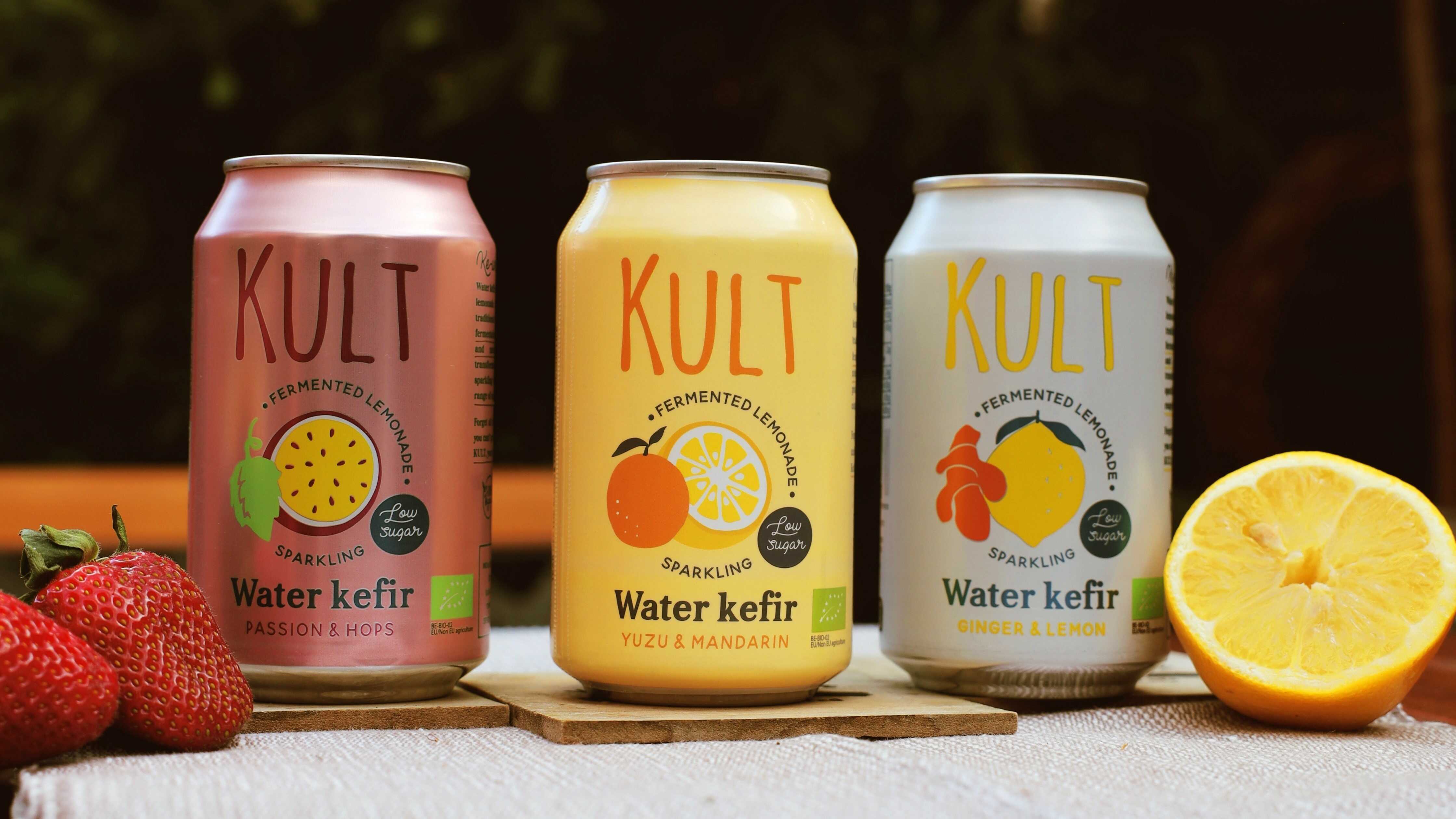
Why did we choose Kult Kefír?
The KULT brand is more than just a drink – it’s a story that brings together science, tradition and care for health. The name “Kult” comes from the Indo-European word kwel, which refers to a cyclical process – just like fermentation itself, a natural biological process that benefits the body.
Behind Kult Kefír is a young bioscientist who connected her passion for microbiology with the craft of fermentation, creating a drink that takes everyday lemonade-style refreshment a few levels further.
- Naturally fermented, functional and tasty
- Kult Kefír is a naturally sparkling drink made in small batches, with an emphasis on quality and effect. Nearly 48 hours of fermentation allows most carbohydrates to break down, resulting in a drink with low sugar, also suited to a keto diet.
- Rich in naturally occurring soluble fibre
- During fermentation, soluble fibre forms as a natural by-product of the metabolism of lactic acid bacteria and yeast. This fibre supports healthy gut microflora and contributes to the drink’s prebiotic effect.
- Full of postbiotics
- Thanks to fermentation, Kult Kefír also contains postbiotics – biologically active substances produced by microorganisms that may have a positive effect on immunity, digestion and overall balance in the body. They are being studied for their beneficial effect on metabolic disorders.
- Different flavours, the same benefit
- Each flavour brings a distinctive experience. Where technology allows, fresh, cold-pressed juices are used. All drinks share: functionality, refreshment and minimal sugar.
- Functional, lower-impact packaging
- Kult Kefír comes in a lightweight, fully recyclable can that protects the contents from light and air. This helps keep the drink more stable and preserves its beneficial components.
- Vegan, gluten-free, keto-friendly
- The company considers everyone – it contains no lactose or animal ingredients, so vegans and those following keto or a low-carb diet can enjoy it too.
Kult Kefír is a balanced blend of postbiotics, prebiotics and natural refreshment. An ideal choice for anyone looking for more than just lemonade – a drink that tastes good and also looks after the body.
There are countless fermented drinks and lemonades with probiotics and prebiotics on the market – but they’re not all equal. When choosing, always focus on:
- Ingredients – simple, natural ingredients without preservatives
- Storage – to preserve beneficial cultures, conditions must be maintained throughout the distribution chain.
- Packaging – plastic is not a suitable packaging material, especially for actively sparkling drinks. And it’s not the best choice from an environmental perspective either.
Remember: the more natural the fermentation process, the greater the benefit for digestion, immunity and overall health.
Did you find the article useful? Share it with your friends using the button below. If you don’t want to miss more interesting updates, subscribe to our news and follow us on social media.
Under EU regulations, the blog cannot link to web pages with a promoted product. You can, of course, find the products on our website Pravé Bio.
Sources used
- Official Poppi website. Available here.
- Official Living Things website. Available here.
- Bacilli bio limonáda - Kombucha Jasmín, 330 ml. Nemleko e-shop. Available here.
- Official Kult kefír website. Available here.
- Potential of postbiotics for the treatment of metabolic disorders. Drug Discov Today. 2024, PubMed. Online. Available here.
- Postbiotics: Metabolites and mechanisms involved in microbiota-host interactions. Trends in Food Science & Technology. 2021. Online. Science Direct. Available here.
- Water kefir, a fermented beverage containing probiotic microorganisms: From ancient and artisanal manufacture to industrialized and regulated commercialization. 2022. Online. Science Direct. Available here.
- Traditional low-alcoholic and non-alcoholic fermented beverages consumed in European countries: a neglected food group. 2017. Cambridge university press. Online. Available here.
ŠárkaShe has devoted her education and professional life to the world of gastronomy and nutrition. After studying hospitality and human nutrition, she completed her training with a qualification as a nutrition therapist, giving her a rounded perspective on the link between food and health.
She now uses this knowledge mainly when caring for her kids.
She’s not afraid of challenges and opportunities, believes in new beginnings, and values a sustainable lifestyle. Outside her profession, she enjoys gardening, hiking and, above all, her family, which remains her biggest anchor in life.