Why “organic collagen” doesn’t exist (and how to make sense of it)
Collagen is a structural protein and a magnet for marketing. The term “organic collagen” is misleading: “organic” does not describe the collagen molecule, but the way the raw material is farmed at source (e.g. cattle rearing or fish aquaculture). It’s a distinction worth knowing.1
Article contents
What “organic” actually means
EU organic regulation applies to agricultural products and their processing. It governs how animals are raised, crops are grown or aquaculture is run, and how raw materials are then processed and labelled. The collagen molecule itself is not changed by that “organic” label. And products from wild-caught fish (a typical source of marine collagen) cannot be considered organic, because the process cannot be fully controlled.1
Collagen vs collagen peptides: why “hydrolysed” matters on the label
In supplements, you’ll most often find hydrolysed collagen peptides – collagen that’s been “broken down” into smaller pieces that dissolve more easily. Clinical data show that, after ingestion, di- and tripeptides containing hydroxyproline (e.g. Pro-Hyp) appear in the blood, regardless of the source (bovine/marine) and differences in molecular weight. This supports the practical reason manufacturers choose hydrolysis: it speeds up and simplifies breakdown and absorption.2
What the studies say: skin and joints (briefly, without hype)
Meta-analyses on skin report improvements in hydration and elasticity with hydrolysed collagen compared with placebo; study quality varies, and authors call for further independent RCTs (randomised controlled trials).3
For joints, a meta-analysis of collagen peptides suggests reduced knee pain vs placebo, with notes on data limitations and the need for more robust studies.4
In practice: in clinical protocols for skin, doses around 1.65–2.5 g/day (12 weeks) and above are tested; figures vary depending on the specific RCT.5
“Organic collagen” on the pack? What to look for instead
More important than the word “organic” is a transparent label and processing quality:
- Form and dose: clearly stated collagen peptides and grams per serving. (Hydrolysates tend to dissolve more easily.)3
- Source: marine (fish) vs bovine (cattle) – choose based on taste, tolerance and your own values.
- Allergens: with marine collagen, remember that fish are a regulated allergen and should be declared under the consumer food information rules.6
- Purity and testing: look for COA (certificate of analysis) / reports (microbiology, heavy metals).
- Added ingredients: decide whether you want sweeteners or flavourings, or a pure product without added extras.
Vitamin C, yes. “Miracle” claims, no
In the EU, there is an authorised claim that vitamin C contributes to normal collagen formation (for skin, cartilage, etc.). That is different from claims about the effects of collagen itself.7
Quick takeaway (pocket version)
- “Organic” ≠ a property of collagen, but the origin of the raw material and the way it is farmed.1
- Look for hydrolysed peptides, a clear dose, and quality testing.3
- With marine products, keep fish as an allergen in mind.6
- Vitamin C has an authorised claim related to collagen formation.7
How we choose for you at PravéBio
- Raw material origin and genuine “organic”
In the EU, “organic” describes the farming method and processing, not a property of the collagen molecule. That’s why we require a traceable origin and clear source labelling. - Transparent labelling and allergens
We prefer clear wording such as hydrolysed collagen peptides + dose in g/serving, and correct allergen declarations. - Quality and independent testing
- We insist on a COA (microbiology, heavy metals) and favour brands with third-party verification: USP Verified and, for athletes, Informed Sport (batch testing for prohibited substances).
- A form supported by evidence
We prioritise hydrolysed peptides – meta-analyses and RCTs show improvements in skin hydration and elasticity compared with placebo; the effect increases with duration of use. After ingestion, di-/tripeptides (e.g. Pro-Hyp) appear in the blood, which supports biological plausibility.
Which brands do we stock?
Brands that state the source (marine/bovine), provide a COA, maintain consistent quality, and communicate dosage and testing transparently (ideally with USP/Informed Sport).
With us, you’ll find brands such as
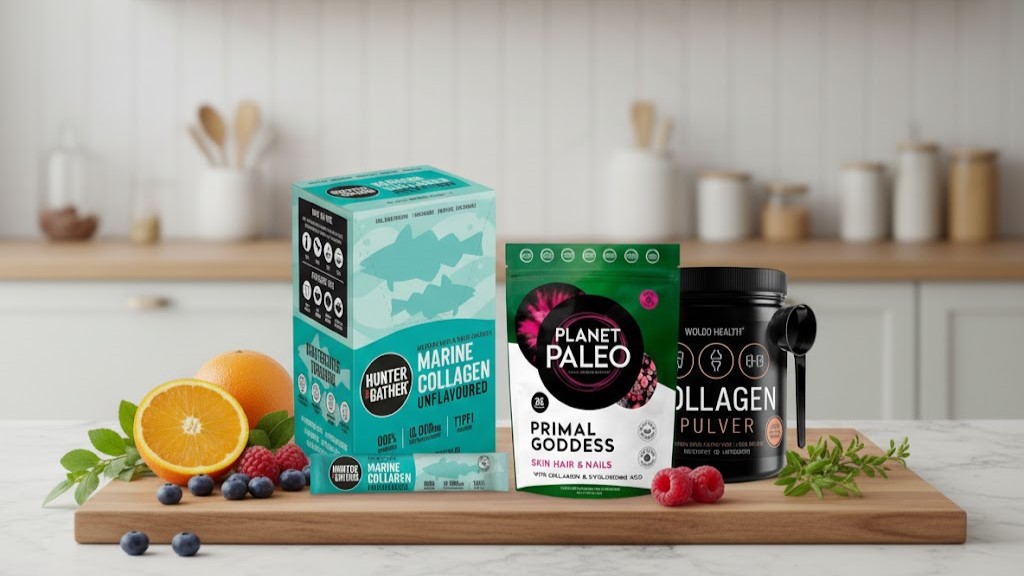
- Planet Paleo – premium hydrolysed collagen from grass-fed bovine cattle (including specialist blends such as Digestive/Osteo). A clear focus on traceable sourcing and a clean formula.
- NoordCode – a Dutch biohacking brand: Pure (pure bovine) and Complete (multi-source mix + vit. C). Products are lab tested, without unnecessary additives.
- WoldoHealth – 100% pure bovine collagen, produced and tested in Germany; bovine options also include Halal. Neutral taste, no flavourings.
- Hunter & Gather – clean hydrolysed collagen peptides from grass-fed bovine (EU origin) as well as marine collagen from wild-caught fish; plus Vanilla Collagen Creamer for easy use in coffee/tea. Transparent composition, with no added fillers.
(You’ll find the full current collagen range in our Collagen category at PravéBio.)
FAQ
Can “marine collagen” be organic?
No, not if it comes from wild-caught fish – these are excluded from organic legislation; for aquaculture there are rules, but “organic” still describes the farming method, not the collagen molecule.1
Which form is studied most?
Most commonly hydrolysed collagen peptides; meta-analyses describe improved skin hydration and elasticity vs placebo, with caveats around variability between studies.3
How long should you try it for?
Skin studies often run for 8–12 weeks with a daily dose in the region of 1.65–2.5 g (and more, depending on the specific protocol). As you try it, monitor tolerance and whether it feels worthwhile for you..5
Collagen is one of today’s most closely watched supplements – whether the focus is joints, hair or skin. For normal collagen formation, vitamin C matters, and it shouldn’t be missing from the diet. Choosing the right collagen isn’t about a fashionable label, but about verified quality and combining it with nutrients that help support its effect. Composition, purity and quality lab testing (COA) will tell you more than the marketing on the pack.
Did you find the article useful? Share it with your friends using the button below. If you don’t want to miss more useful updates, subscribe to our news and follow us on social media.
Under EU regulations, the blog cannot link to web pages featuring the promoted product. The products are, of course, available on our website Pravé Bio.
Sources
- Regulation (EU) 2018/848 of the European Parliament and of the Council of 30 May 2018 on organic production and labelling of organic products and repealing Council Regulation (EC) No 834/2007. 2018. EUR-Lex. Available here.
- Absorption of bioactive peptides following collagen hydrolysate intake: a randomized, double-blind crossover study in healthy individuals. 2024. Froniers Nutrition. Available here.
- Effects of Oral Collagen for Skin Anti-Aging: A Systematic Review and Meta-Analysis. 2023. Nutrients. Available here.
- Analgesic efficacy of collagen peptide in knee osteoarthritis: a meta-analysis of randomized controlled trials. 2023. Journal of Orthopaedic Surgery and Research, Available here.
- Oral intake of collagen peptide NS improves hydration, elasticity, desquamation, and wrinkling in human skin: a randomized, double-blinded, placebo-controlled study. 2023. Food Funct. Available here.
- Regulation (EU) No 1169/2011 of the European Parliament and of the Council of 25 October 2011 on the provision of food information to consumers. 2011. EUR-Lex. Available here.
- Scientific Opinion on the substantiation of health claims related to vitamin C and protection of DNA, proteins and lipids from oxidative damage (ID 129, 138, 143, 148), antioxidant function of lutein (ID 146), maintenance of vision (ID 141, 142), collagen formation (ID 130, 131, 136, 137, 149), function of the nervous system (ID 133), function of the immune system (ID 134), function of the immune system during and after extreme physical exercise (ID 144), non-haem iron absorption (ID 132, 147), energy-yielding metabolism (ID 135), and relief in case of irritation in the upper respiratory tract (ID 1714, 1715) pursuant to Article 13(1) of Regulation (EC) No 1924/20061. 2009. EFSA Journal. Available here.
ŠárkaShe has dedicated her education and professional life to gastronomy and nutrition. After studying hospitality and human nutrition, she completed her training as a nutrition therapist, giving her a well-rounded view of the connection between food and health.
She now applies this knowledge mainly in caring for her children.
She isn’t afraid of challenges and opportunities, believes in new beginnings, and values a sustainable lifestyle. Outside her profession, she enjoys gardening, hiking, and above all, her family, which remains her strongest anchor in life.