
ENERGYbits® Spirulina & Chlorella: How Green Superfoods Power Modern Nutrition
Are you missing energy, feeling under stress, or simply thinking about the future? Green superfoods such as spirulina and chlorella in their pure form are among the most thoroughly researched natural foods. Not as medicine. But as a concentrated source of nutrients in a natural form. Read on to see the contexts in which they are being studied, and whether adding them could fit into your daily routine.
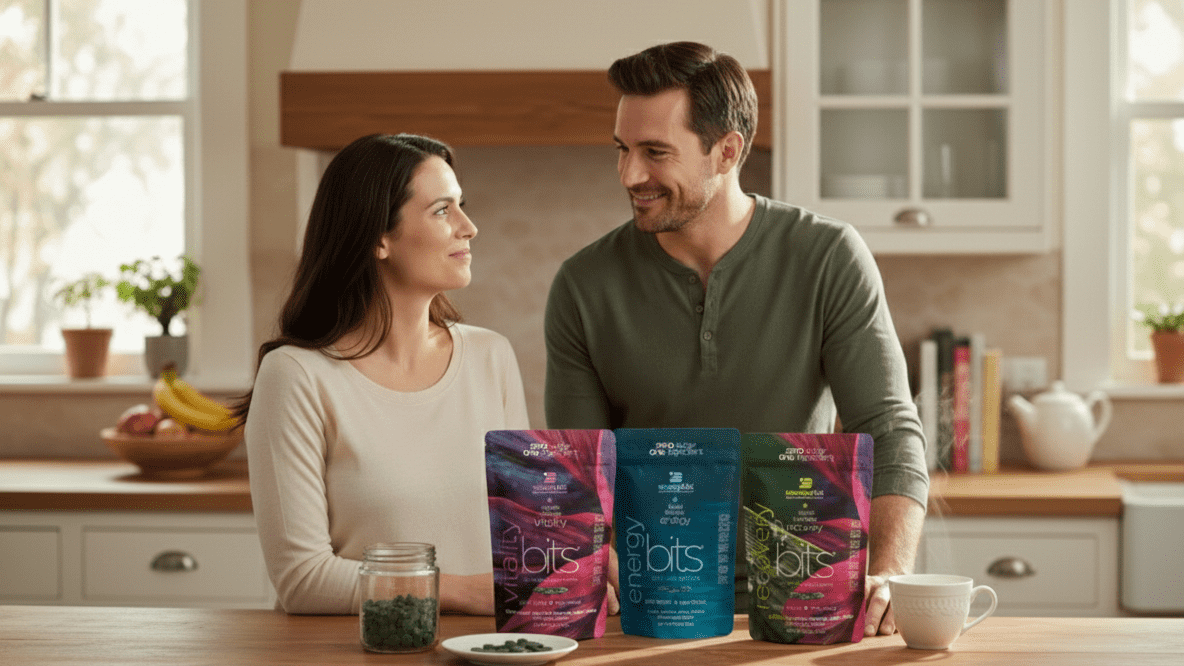
ENERGYbits® products bring you spirulina and chlorella with no fillers or additives, as 100% whole food — which research suggests is the most effective form for bioavailability.
Contents
What are spirulina and chlorella – and why are people interested in them?
Spirulina is a microscopic cyanobacterium that is being studied for its content of:
- plant protein and its bioavailability,
- naturally occurring micronutrients,
- bioactive compounds associated with energy metabolism.
Chlorella is a freshwater microalga that is researched mainly in connection with:
- chlorophyll content,
- oxidative balance,
- binding to laboratory markers of physiological load.
Green foods are a practical source of nutrients in a concentrated form. They are not a replacement for an everyday diet. We are talking about a modern nutrition add-on that has been known for years. This is not “detox” or stimulation. Research focuses on how these microorganisms fit into the overall nutrition of cells.3
Who might benefit from spirulina and chlorella?
Because of their nutrient content, they are popular with vegetarians and vegans, as well as people limiting animal products. The researched links may also be relevant to the wider public.
Do any of these situations sound familiar?
- Your energy fluctuates during the day,
- you don’t want more stimulants,
- you’re dealing with long-term load,
- you have ethical dietary restrictions,
- you’re looking for a simple, no-nonsense supplement.
From the perspective of modern nutrition, it can make sense to consider adding spirulina and/or chlorella to a daily ritual.
What effects of spirulina and chlorella is modern science exploring?
Spirulina and chlorella are being studied as nutrient-dense foods that may fit into a long-term approach to nutrition and managing day-to-day load. They are popular dietary supplements among people interested in intermittent fasting, biohacking and longevity. They are also increasingly used by managers and people with an interest in modern nutrition. 1
On fasting, you can read our articles Fasting: What happens in the body when we stop eating? and Biohacking and fasting: A route to a stronger, healthier you
Want to support energy without stimulants?
Short-term energy boosters like coffee, energy drinks or sugar aren’t your thing? Spirulina and chlorella are being studied in the context of long-term nutrient intake. Nutrient availability is one of the factors being explored in relation to cellular processes.
Spirulina and chlorella are not a quick fix for fatigue, but dietary supplements that can fit into a long-term approach to nutrition.1
Are you struggling with oxidative stress?
People often reach for green foods when they want to give the body a wider spectrum of protective compounds from a natural source — not to solve an acute problem.
Do you recognise yourself in any of these situations?
- a mentally or physically demanding job,
- lack of sleep,
- feeling the impact of the passing years.
In these cases, oxidative stress can occur. The body handles this load with the help of antioxidants and other bioactive compounds.
This isn’t “detox” or “treatment”, but rather:
- the relationship between intake of microorganisms
- and laboratory markers of oxidative load.4
How the body changes as we age is covered in our article On the road to longevity I – spermidine.
Do you want to give your body the recovery it needs for everyday life?
Tissue renewal is also important for:
- parents of (young) children,
- people with mentally demanding work,
- anyone with an irregular routine.
The findings are not a treatment claim, but they suggest that spirulina is an interesting research topic for people with an active lifestyle. 4
Why care about cellular nutrition before problems appear?
As we get older, the following can change:
- how the body manages nutrients,
- the speed of cell renewal,
- tolerance to stress.
In recent years, research into green microorganisms has also focused on:
- cardiometabolic links,
- relationships with blood lipids and blood pressure,
- the role of overall lifestyle.2
So, in everyday terms…
Green superfoods aren’t a “problem solver”, but part of preventive thinking about nutrition. Thanks to a combination of different nutrients, spirulina and chlorella offer a broad nutritional spectrum — which is why they’ve remained of long-term interest in modern nutrition.
What’s the difference between spirulina and chlorella?
At a cellular level, the difference lies in the presence (or absence) of a cell nucleus. Spirulina, as a type of cyanobacterium, does not have a nucleus, while chlorella, as an alga, does. Cyanobacteria are classed as bacteria, whereas algae are plants.
From a nutrition perspective, you could sum it up like this: spirulina is more often used in the context of energy, while chlorella is associated with long-term vitality.
When to take spirulina?
Consider adding spirulina to your daily routine if you:
- are in a demanding work period,
- exercise or are very active,
- feel long-term fatigue,
- are interested in cell nutrition in a broader context without stimulants.
It’s often used in the morning or before exertion.
When to take chlorella?
Consider adding chlorella to your daily routine if you:
- are focusing on overall balance in the body,
- want to support a varied, natural diet,
- are prioritising long-term vitality.
It’s often part of a long-term routine.
The less “chemistry” and intervention, the better spirulina or chlorella tend to fit into a long-term approach to nutrition.
How to include spirulina and chlorella in your diet – and why choose ENERGYbits®?
ENERGYbits® products contain 100% dried spirulina and/or chlorella in tablet form. No mixing with liquids, no worries about taste or texture. They are also suitable for people following a vegan, keto or paleo diet.
- One ingredient = maximum clarity.
- No additives or binders.
- No iodine.
- Whole food, not an extract.
- Simple dosing (tablets, no mixing).
This matters especially for people who:
- don’t want complicated supplementation protocols,
- want to know what they’re actually taking,
- are looking for a sustainable long-term approach.
It’s a whole food, not an extract. That matters because current findings suggest that the effects of spirulina and chlorella come from their natural combination of nutrients, not from one isolated compound.5
You can read the full ENERGYbits® story on our website.
The information in this article is for educational purposes. Food supplements are not a substitute for a varied diet or a healthy lifestyle. The referenced scientific studies examine individual substances, not the effects of specific products. Individual results may vary.
Did you find the article helpful? Share it with your friends using the button below. If you don’t want to miss future updates, subscribe to our news and follow us on social media.
Under EU regulations, we cannot link from the blog directly to pages featuring promoted products. You can, of course, find the products on our website Pravé Bio.
FAQ
- Is spirulina or chlorella suitable for everyone?
- This supplement is used by people and animals. However, it may not suit everyone. These are foods with a high concentration of nutrients, so it’s best to start gradually and pay attention to how your body responds. For children, you may wish to consult a paediatrician; for pets, speak to your vet.
- What is the main difference between spirulina and chlorella?
- Spirulina is more often associated with energy and load, while chlorella is linked to overall balance in the body. In practice, they are often combined.
- When is the best time to take spirulina or chlorella?
- Spirulina is commonly taken in the morning or before activity, while chlorella is more often used as part of a long-term daily routine. It depends on individual needs.
- Are green foods a replacement for a balanced diet?
- No. They are an addition, not a replacement for a well-balanced diet and a healthy lifestyle.
- Why choose a whole food instead of an extract?
- Because research suggests the effects of microalgae come from their natural complexity, not from a single isolated compound.
Sources used
- Antioxidant, anti-inflammatory and immunomodulatory effects of spirulina in exercise and sport: A systematic review. 2022. Front Nutr. Available here.
- The Role of Chlorella and Spirulina as Adjuvants of Cardiovascular Risk Factor Control: A Systematic Review and Meta-Analysis of Randomised Controlled Trials. 2025. Nutrients. Available here.
- Physicochemical, functional, and nutraceutical properties of Spirulina and Chlorella biomass: A comparative study. 2024. Algal Research. Available here.
- Antioxidant, anti-inflammatory and immunomodulatory effects of spirulina in exercise and sport: A systematic review. 2022. Front Nutr. Available here.
- Official ENERGYbits® website. Available here.
ŠárkaShe devoted her education and professional life to the world of gastronomy and nutrition. After studying hospitality and human nutrition, she completed her training with a qualification as a nutritional therapist, giving her a well-rounded perspective on the connection between food and health.
Today, she uses this knowledge primarily in caring for her children.
She embraces challenges and opportunities, believes in new beginnings, and values a sustainable lifestyle. Outside of her profession, she enjoys gardening, hiking and, above all, her family, which remains the greatest cornerstone of her life.