
Homemade bread: a return to the roots of healthy baking
Homemade sourdough bread is winning over more and more people – not only for its distinctive flavour and crisp crust, but also thanks to natural fermentation, which is gentler on digestion. This traditional way of baking bread goes back thousands of years – the first references to fermented bread come from Ancient Egypt. Back then, sourdough starter was a happy accident; today it’s a valued ingredient that brings health and authenticity into our kitchens.
At a time when supermarket bread is often made with dough improvers and additives, baking sourdough bread at home is a return to simplicity and natural ingredients. This sourdough bread recipe shows that with a little patience you can make a fragrant loaf that stays fresh for longer, keeps you fuller, and genuinely does your body good.
Whether you’re a beginner or an experienced home baker, sourdough teaches you to slow down, pay attention to your ingredients, and enjoy every good loaf. Let’s get started – here is a homemade sourdough bread recipe, adapted by Jana Čevelová.
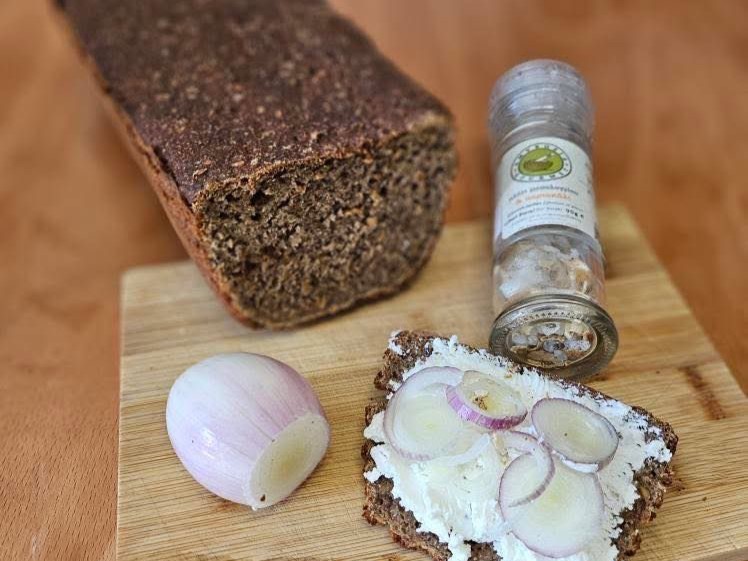
A tried-and-tested homemade bread recipe by Jana Čevelová from Pravé Bio
This homemade sourdough bread recipe isn’t just another one – it’s baked regularly by Jana Čevelová, co-founder of Pravé Bio, and she keeps refining it towards perfection. It’s ideal for anyone who wants a loaf without complicated folding and multiple rises.
The best homemade sourdough bread is straightforward – mix all the ingredients, put them into a tin, leave to rise and bake. And with added jackfruit flour, which has a lower glycaemic index than standard flours, this sourdough bread is more suitable for stabilising blood sugar levels. That’s helpful not only for people with blood sugar fluctuations, but also for anyone looking for a healthier alternative to bread.
Ingredients
- 300 g active sourdough starter
- 100 g coarsely ground wholegrain flour PROBIO
- 100 g jackfruit flour from Ceylon Kokonati
- 150 g rye bread flour PROBIO
- 1 tablespoon of honey
- 1 teaspoon of salt
- caraway seeds,
- 250 ml water
- optional, to taste
- a pinch of Purely ZINC Plus from NAHS
- seeds (sunflower, hemp)
Method
- Mix all ingredients together and pour into a greased tin (or one lined with baking paper).
- Wrap the tin with the bread in a tea towel, or cover with cling film (so it doesn’t dry out). Leave to rise for 2 - 3 hours in a warm place, until it doubles in volume.
- Heat the oven to 250 degrees – top and bottom heat. Let it heat up properly. Put a tray of water on the bottom of the oven (this keeps the loaf moist).
- Now you can put the bread into the oven, and after 10 minutes reduce the temperature to 200 degrees.
- Bake for a further approx. 40 - 45 minutes.
- Once out of the oven, remove the bread from the tin and leave it to cool on a wire rack. Slice only when it has cooled.
Our tips
- You can add whatever you like to the loaf – from different herbs (for example thyme), to smoked meat, pork crackling, or nuts.
The most common questions you might have when baking bread (FAQ)
Why bake sourdough bread?
Baking sourdough bread has plenty of benefits – both in flavour and from a health perspective. Sourdough is a natural starter created by fermenting flour and water. Thanks to the long fermentation, nutrient absorption improves, the level of phytates (which reduce mineral absorption) decreases, and the bread is easier to digest.
Sourdough bread also has a lower glycaemic index than standard yeasted bread, stays fresh for longer, and has a deeper, fuller flavour. If you’re looking for a healthier homemade bread alternative, sourdough is the clear choice.
What is jackfruit flour, and why use it in bread?
Jackfruit flour is made from dried unripe jackfruit, a tropical fruit with a high fibre content. It has a fine texture and a low glycaemic index, which helps stabilise blood sugar levels after eating.
In this sourdough bread recipe, we add jackfruit flour not only for its health benefits, but also for the gentle sweetness and softness of the dough. It’s a great alternative to classic wheat flour and fits naturally into modern recipes focused on healthy eating.
How do I know my sourdough starter is ready to use?
Sourdough starter is ready when it doubles in volume, has a pleasant tangy aroma, and is full of bubbles. A simple check is the so-called "float test" – a small drop of starter floats on the surface of water.
What should I do if the dough doesn’t rise?
If the dough doesn’t rise, your starter may be weak or too young. Make sure your starter is active and well fed. Also check the temperature – ideally around 24–26 °C.
How long does sourdough bread stay fresh?
Homemade sourdough bread stays fresh for 4–5 days when stored properly. It’s best kept wrapped in a linen bag or a tea towel in a cool, dry place.
How should I store sourdough bread?
Store the bread in a linen bag or wrapped in a tea towel, so it can breathe and won’t go mouldy. Avoid plastic packaging, which traps moisture.
What if the bread is too dense or doesn’t rise enough?
Dense bread can be the result of insufficient rising or a weak starter. Make sure the dough has enough time to rise and that your starter is active. Also keep an eye on the correct ingredient ratios and dough hydration.
What are the most common mistakes when baking sourdough bread?
Common mistakes include insufficient or over-proofing, a weak starter, incorrect dough hydration, the wrong baking temperature, and not preheating the oven properly. It’s also important to let the bread cool fully after baking.
Under EU regulations, we can’t link from the blog to web pages featuring a promoted product. You can, of course, find the products on our website Pravé Bio.