
Omega-3 and omega-6: The balance of fats that affects health
These days there’s increasing talk about healthy fats, anti-inflammatory eating, and the impact of nutrition on immunity as well as mental wellbeing. And that’s exactly where omega-3 and omega-6 fatty acids play a key role. It’s not just about how much healthy fat you get, but above all their balance in the diet. So why is the omega-3 to omega-6 balance so important?
Let’s take a closer look at the role of omega-3 and omega-6, how they work in the body, what their natural sources are, and how to optimise their balance to support health and vitality.
Article contents
What are omega-3 and omega-6 fatty acids?
Omega-3 and omega-6 are polyunsaturated fatty acids (PUFA) that the body can’t produce on its own, so we need to get them from the diet. The body then uses them to form bioactive compounds that act in tissues.
Most common forms
- From the omega-3 family:
- ALA, or alpha-linolenic acid
- EPA and DHA – eicosapentaenoic acid and docosahexaenoic acid
- The body can produce them from ALA, but usually not in sufficient amounts.
- From the omega-6 family:
- LA, or linoleic acid
- AA, or arachidonic acid
- They form part of the phospholipid layer of cell membranes, contributing to their function (flexibility, conductivity and sensitivity).
- Regulation of inflammatory processes, as omega-3 and omega-6 are precursors of eicosanoids (prostaglandins, leukotrienes, thromboxanes) and other biologically active compounds. In the body, these influence:
- Inflammation and healing
- Blood clotting
- Constriction of blood vessels
- Immune responses
- Nervous system function
- Eicosanoids and bioactive compounds from the omega-6 family drive inflammation – the body defends itself (pain, swelling, fever, higher blood clotting, narrowing of blood vessels, mobilisation of white blood cells). This can be helpful, for example, in acute injuries or inflammation.
- Then compounds from the omega-3 family help bring inflammation to an end and support healing.
- This is one reason why it’s not only intake (amount) that matters, but also the ratio of the two.
- Excess omega-6 intake (which is common today) may contribute to inflammation in the body, which is linked with lifestyle-related conditions such as diabetes, obesity and autoimmune disorders.
- For the reasons above, omega-3 – alongside an appropriate balance with omega-6 – has a positive effect on the immune system (dampening the body’s reactions).
- Omega-3 is a component of the brain, retina and myelin, which is why it supports nervous system and eye health.
- Omega-3 fatty acids have a positive effect on the heart and blood vessels.
Why take EPA and DHA if the body can make them from ALA
Although the body can convert plant-based omega-3 ALA (for example from flaxseed or chia oil) into EPA and DHA, this conversion process is very inefficient.
Research suggests that, for most people, only 5–10 % ALA converts to EPA, and just 0,5–5 % to DHA. Conversion efficiency tends to be lower in women after the menopause, men, and people with inflammatory conditions or a high omega-6 level.
Supplementing with EPA and DHA is therefore the most reliable way to ensure a sufficient amount of these biologically active forms of omega-3.
Omega-3 vs. omega-6: Finding the balance
While our ancestors consumed omega-3 and omega-6 in a ratio of roughly 1:1, today a ratio of 1:10 is common – or worse – in favour of omega-6. This imbalance puts strain on the body and increases the risk of chronic inflammation.
Ideal ratio?
According to experts, we should aim for a ratio of 1:1 až 1:4 omega-3 to omega-6. For EPA and DHA, it depends on the reason for use.4,5
According to EFSA, the recommended daily amount of EPA and DHA is 250 mg and 500 mg. It also states that a combined intake of EPA and DHA can be considered safe up to 5 g/day.3
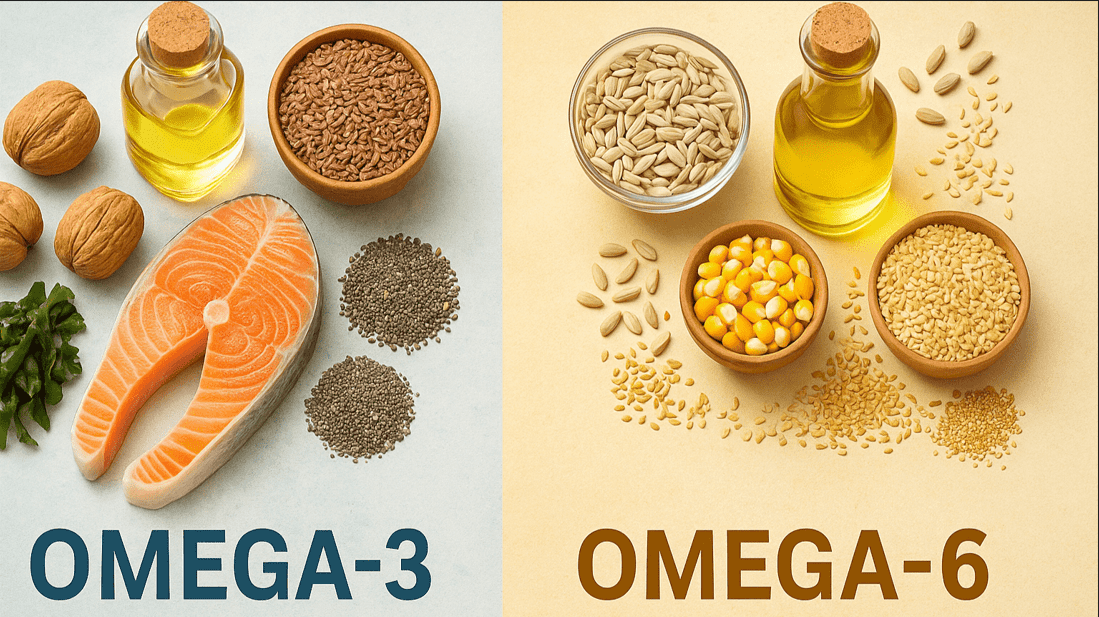
Sources of omega-3 and omega-6
| Omega-3 | Omega-3 | Omega-6 |
|---|---|---|
| ALA | EPA and DHA | AL |
| Flaxseed oil | Marine algae | Sunflower oil |
| Chia seeds | Krill | Maize oil |
| Hemp oil | Fish oil from fish that obtain the above | Soya oil |
| Walnuts | Calanus oil |
Grinding and soaking seeds increases the bioavailability of the compounds they contain.
Plant sources are a great option for vegans, but it’s worth knowing that ALA only converts to EPA and DHA in limited amounts. That’s why it can make sense to consider food supplements from marine algae.
How can you adjust the balance of fats in your diet?
How to increase omega-3
For example, add the following to morning porridge, overnight yoghurt, smoothies, salads or cooked soups:
- Flaxseed oil (cold-pressed)
- Hemp oil
- Walnuts, chia, flaxseed
To top up EPA and DHA, include fattier oily fish in your diet at least 1× a week, add marine algae, or consider supplements containing EPA and DHA.
How to reduce omega-6
Limit your intake of:
- Industrially processed foods (fast food, ready meals).
- Margarine and fried foods cooked in refined oils.
- Excess sunflower or maize oil.
Fat quality matters. Look for cold-pressed oils in organic quality, store them cool and in the dark to prevent unnecessary oxidation, and don’t use them for cooking. Ideally, add them to salads, porridge, smoothies or prepared dishes.
Gentler ocean nutrition: a new omega-3 source called Calanus
Calanus oil represents a new generation of omega-3 fatty acids that has drawn attention from experts around the world. It’s sourced from the marine crustacean Calanus finmarchicus, which lives in the clean waters of the North Atlantic, and contains omega-3 in the form of wax esters – a natural, stable form that the body processes gradually and efficiently. Research suggests this form may offer better bioavailability than traditional fish oils and can be gentler on digestion. With EPA, DHA and naturally occurring astaxanthin, it provides broader support for the heart, brain and cellular balance.
From a sustainability perspective, this is a meaningful step forward – calanus is one of the most abundant marine organisms, and harvesting is strictly regulated to protect the marine ecosystem. Experts value not only its nutritional value, but also the environmental profile of this raw material.
Our selection of global brands
Zinzino is a Swedish–Norwegian company specialising in innovative supplements and personal testing systems. It’s best known for the BalanceOil range, which combines fish or algae oil rich in EPA/DHA with extra virgin olive oil full of polyphenols and natural vitamin D₃.
Naturtreu is a German brand built around a blend of plant-based ingredients, environmental responsibility and a transparent approach to formulation. All products – including omega-3 from algae – are lab-tested, 100 % vegan, free from GMOs, colourings and additives, and not tested on animals. The company highlights climate-neutral operations certified institutionally, as well as support for projects such as rainforest restoration in Uganda. Overall, it’s a brand that prioritises minimalist formulations and environmental impact.
NoordCode is a European (Dutch–Norwegian) company focused on premium nutritional supplements, with an emphasis on clean, non-oxidised, organic ingredients and manufacturing within the EU without compromising on quality. Their approach centres on direct sourcing from sustainable suppliers – backed by certifications such as Friend of the Sea and lab testing for purity, oxidation and contaminants.
|
Fish oil - Balance oil +Premium |
Omega-3 from marine algae - AlgenKraft |
Ultimate Omega - Calanus® zooplankton oil |
Möllers Omega 3 Fish Oil Natural6 |
||
|---|---|---|---|---|---|
|
Source |
fish oil from anchovies, mackerel, sardines | marine algae Schizochytrium sp. | zooplankton Calanus finmarchicus | from cod liver | |
| Amount EPA and DHA |
12 ml contains 1283 mg EPA and 683 mg DHA | 2 capsules contain 150 mg EPA and 300 mg DHA | 2 capsules contain 69 mg EPA and 51 mg DHA | 5 ml contains 370 mg EPA and 510 mg DHA | |
| Additional ingredients | polyphenols from Koroneiki olive oil, vitamin D3, antioxidants | rosemary extract, tocopherols | natural astaxanthin | vitamins E and D |
Omega-3 and omega-6 fats aren’t “good” or “bad” – it’s about balance. A healthy diet isn’t about extremes, but informed choices and small changes that add up to greater comfort, better immunity and health without chronic inflammation, with respect for the environment.
Did you find the article useful? Share it with your friends using the button below. If you don’t want to miss more interesting updates, subscribe to our news and follow us on social media.
Under EU regulations, we can’t link from the blog to websites featuring the promoted product. You can, of course, find the products on our website Pravé Bio.
Sources
- Daily Consumption of α-Linolenic Acid Increases Conversion Efficiency to Eicosapentaenoic Acid in Mice - PMC. (2024). PMC Home. Available here.
- Scientific Opinion on the Tolerable Upper Intake Level of eicosapentaenoic acid (EPA), docosahexaenoic acid (DHA) and docosapentaenoic acid (DPA). 2012. European Food Safety Authority. Available here.
- A double-blind, randomized controlled clinical trial comparing eicosapentaenoic acid versus docosahexaenoic acid for depression - PubMed. (2015). PubMed. Available here.
- DHA, EPA and their combination at various ratios differently modulated Aβ25-35-induced neurotoxicity in SH-SY5Y cells - PubMed. (2018). PubMed. Available here.
- Protective effects of various ratios of DHA/EPA supplementation on high-fat diet-induced liver damage in mice - PMC. (2017). PMC Home. Available here.
- Möller´s Omega-3 Fish Oil Natural. Official Möllers website. Available here.
ŠárkaShe has dedicated her studies and professional life to the world of gastronomy and nutrition. After studying hospitality and human nutrition, she completed her training with a qualification as a nutrition therapist, giving her a well-rounded view of the link between food and health.
She now uses this knowledge mainly when caring for her children.
She embraces challenges and opportunities, believes in new beginnings, and values a sustainable lifestyle. Outside her profession, she enjoys gardening, hiking and, above all, her family, which remains her greatest anchor in life.