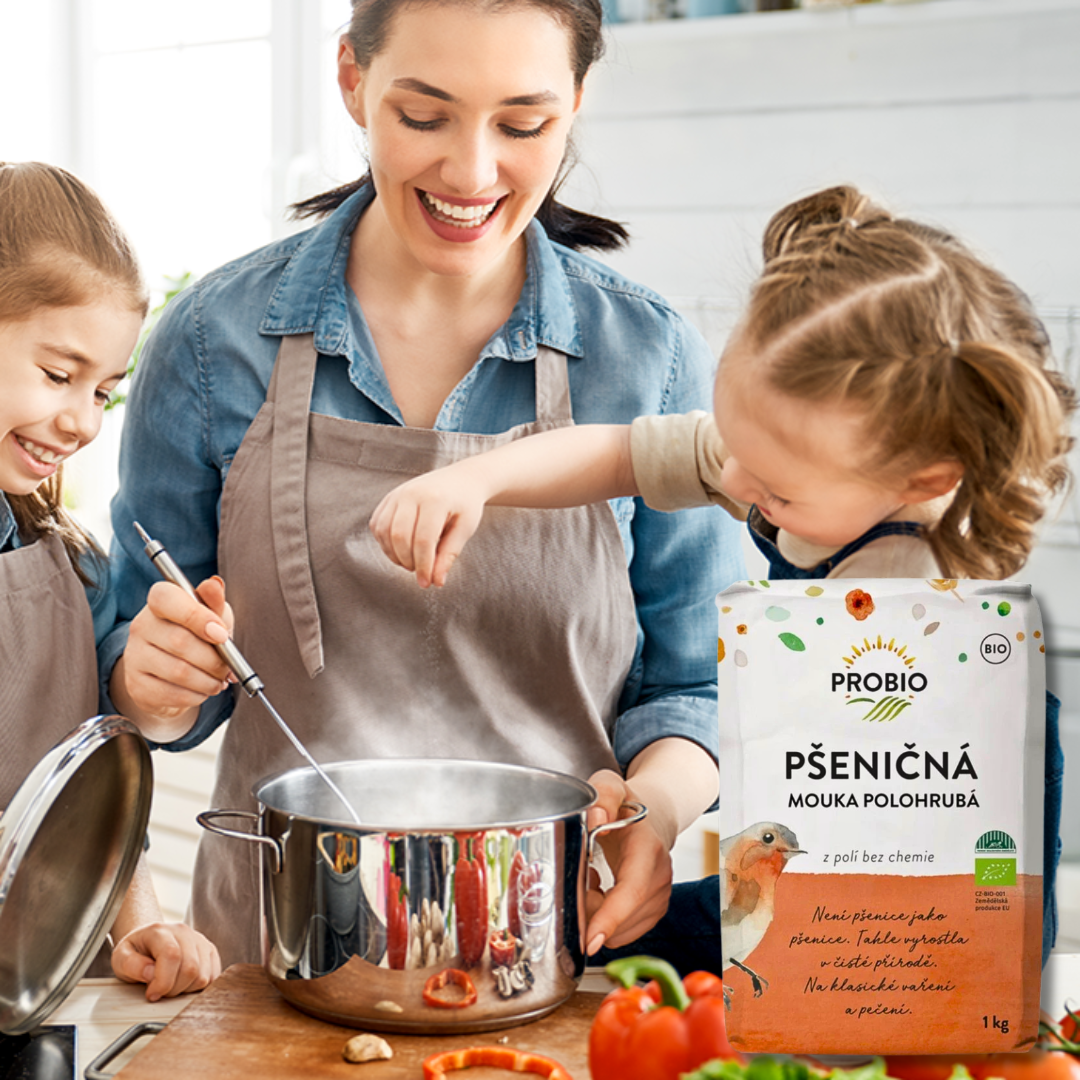
Semi-coarse Wheat Flour BIO • white flour • baking and thickening sauces and soups • 1 kg
Semi-coarse wheat flour is medium-ground bio white flour from wheat (Triticum aestivum) for poured and beaten doughs. It is suitable for bundt cakes, gingerbread, fruit cakes, poppy seed cakes, and yeast buns.
You can also use it in pies and for homemade pastries when you want a fluffy, slightly coarser crumb. In the kitchen, it is also practical for thickening sauces and soups, preparing roux, and crispy batters; it is pure flour without added substances.


PROBIO – Semi-coarse Wheat Flour – Pour and Beaten Doughs, Universal for the Kitchen
Semi-coarse Wheat Flour is a medium-ground organic white flour from wheat (Triticum aestivum) for everyday and festive baking. It offers a pure taste and reliable dough handling.
It excels in pour and beaten doughs – for bundt cakes, gingerbread, fruit cakes, poppy seed cakes, and yeast buns. Equally suitable for pies and homemade pastries with an airy, slightly coarser crumb.
Wheat offers advantages that other flours typically lack: gluten elasticity for volume and fluffiness, exceptional dough predictability, and a neutral taste that doesn't overpower spices. Its balanced composition supports a nice golden color and crispy crust.
Semi-coarse grinding provides support to the dough and promotes even baking. Pastries then hold their shape, are fluffy, and retain the delicate texture favored in traditional recipes.
Besides sweet baking, it's also great for the kitchen: for thickening sauces and soups, preparing roux, and stable batters. PROBIO emphasizes gentle processing and grain quality for consistent results.
Did You Know?
- Gluten in wheat flour creates a flexible network when mixed, which holds CO₂ from leavening. This gives baked goods better volume, shape, and fluffiness.
- Ash content (minerals) determines the “type” of flour: the lower it is, the whiter the flour (more endosperm, less bran and germ). Higher types tend to have more flavor and fiber but a denser crumb.
- A short dough rest after mixing (autolysis 10–20 min) allows the flour to better absorb water and develop gluten. The dough then processes more easily and baked goods have a more uniform structure.
Sources and Literature
- USDA FoodData Central – official nutritional data of wheat flours.
- Whole Grains Council – overview of grain structure and its impact on baking.
- Journal of Cereal Science – study on rheology of wheat dough.
- FAO – wheat as a key global crop.
Suitable for
Prave Bio recommends what to buy
- RealSalt® - Finely ground natural salt in a salt shaker – essential for flavouring doughs, thickened sauces, and soups; fine granularity for even taste.
- Greek Apple Cider Vinegar – for leavening with baking soda in pour batters, in dressings, and for thickened dishes to balance flavour.
- Organic Coconut milk - 90% pulp – for whipped creams, fillings, and savoury sauces; adds richness and a smooth texture.
- Salsa Dip – Mild – quick tomato base for batters, on tortillas, or as a base for a quick sauce.
- Tandoori Sauce – for marinating meats and vegetables, or as a quick base for sauce with dumplings/rice.
- Greek Organic Oregano – for savoury cooking (baked potatoes, batters, sauces); enhances aroma and taste of dishes.
Read more on the topic
• Homemade Bread: A Return to the Roots of Healthy Baking • Easter Linzer Cookies with Coconut Sugar • Vegan Diet and Important Supplements • Magical Christmas with PraveBio.cz • How to Avoid Christmas Overeating or Mitigate Its Effects
Main Benefits of Semi-coarse Wheat Flour from PROBIO
- “Medium granularity” for a fluffy crumb – semi-coarse wheat easily integrates and provides a clean cut without stickiness.
- Reliable performance in pour and beaten doughs – dough holds shape, bakes to a golden brown, and has even leavening for bundt cakes, buns, or pies.
- Light, neutral taste – does not interfere with the profile of desserts or savoury dishes; enhanced by Maillard browning for a nice crust.
- Gluten elasticity for volume – natural gluten creates a flexible network; baked goods are fluffy and maintain structure.
- Versatile use in the kitchen – ideal for bundt cakes, gingerbread, poppy seed cakes, fruit cakes, and yeast buns; also great for thickening sauces and batters.
- Organic origin and gentle milling – sourced from organic farming, freshly milled at PROBIO for consistent and repeatable results.
Coarse wheat flour combines medium granularity, neutral taste, and reliable dough handling – a certainty for sweet and savoury recipes.
For delicate cakes, creams, and sponge bases, choose fine wheat flour; if aiming for loaves, rolls, or yeast dough with a firmer structure, opt for Wheat Bread Flour.
How does wheat differ from other grains?
Wheat (Triticum aestivum) contains natural gluten, which creates an elastic gluten network. This traps CO₂ and gives baked goods volume, shape, and fluffiness – achieving this with gluten-free grains is more difficult without blends. Thanks to this elasticity, wheat is a "bread" crop for a wide range of doughs.
Technologically, it excels in milling versatility and processing behaviour. It offers a range of types (fine/coarse/very coarse), allowing precise tuning of hydration, kneading, rising, and baking. Doughs are well predictable and maintain structure, while with rye or oats, the crumb is more fragile and requires different methods.
In terms of taste, wheat is rather neutral, allowing spices and cocoa to stand out; it also tends to Maillard browning for a golden crust. Nutritionally, it provides complex carbohydrates and plant proteins; whole grain also adds fibre from bran.
Types of flours we offer
- Plain Wheat Flour – versatile for delicate doughs, cakes, and thickening; smooth texture and reliable rising.
- Finely Grounded Whole Rye Flour – ideal for sourdough and yeast bread; higher fibre content, rustic aroma, and elastic crumb.
- Raw Coconut Flour from Ceylon – naturally gluten-free; rich in fibre, suitable for desserts, pancakes, and gluten-free baking.
- Raw Flour from Green Bananas – naturally gluten-free; neutral taste, great for baking, thickening, and porridge.

Why choose PROBIO
PROBIO is the largest producer of organic food in the Czech Republic, specializing in organic farming, quality organic food, and a sustainable approach to nature. With over 120 employees and its own organic farm, it offers a wide range of gluten-free and traditional Czech crops.
The uniqueness of PROBIO products lies in their origin and quality. Ingredients are grown in accordance with organic principles, ensuring their purity and high nutritional value. Add to that strict quality control, transparency of origin of ingredients, and inspiration for healthy cooking.
Thanks to its own organic mills and collaboration with organic farmers across the Czech Republic, PROBIO actively supports local farmers and sustainable agricultural practices.
Try, for example, PROBIO flours or mushroom spelt risotto!

Quality and purity
Products are made from organically grown ingredients without the use of chemicals, guaranteeing authentic taste and high nutritional value.
Transparency and trust
Customers can clearly see the composition and origin of ingredients for each product - making it easy to find out where it comes from and how it was made.
Wide selection
A wide range includes flours, grains, legumes, pasta, and other organic foods ideal for everyday cooking.
Sustainability
PROBIO actively protects nature – minimizing environmental impact and supporting regenerative approaches in agriculture.
Composition
Complete composition
100% coarse wheat flour (Triticum aestivum) – organic.
Allergens: contains gluten.
Nutritional values
| Nutritional values | Per 100 g | What it means for you |
|---|---|---|
| Energy | 1,460 kJ / 344 kcal | Energy shows how many calories you consume. It helps with weight control and performance planning. |
| Proteins | 11.3 g | Proteins are building blocks for muscles, immunity, and recovery. A higher proportion improves the feeling of satiety. |
| Fats | 1.4 g | Fats provide long-term energy and help absorb fat-soluble vitamins. A low amount supports lighter recipes. |
| – of which saturated fatty acids | 0.19 g | Saturated fats should be kept lower. A low content contributes to a balanced diet. |
| Carbohydrates | 69.6 g | Carbohydrates are the main source of energy for the brain and muscles. Typical for grains and baking. |
| – of which sugars | 0.8 g | Sugars quickly affect glycemia. A low content is suitable for monitoring sweets. |
| Fibre | 3.7 g | Fibre supports healthy digestion, longer satiety, and helps stabilize blood sugar level. |
| Salt | 0 g | Salt affects sodium intake. Zero content makes it easier to control daily salting. |
Wheat flour semi-coarse has medium granularity and usually around 11 g of protein and 3–4 g of fibre per 100 g. It is low-fat, with minimal sugars, no added salt and contains gluten.
Composition analysis and functional benefits
100 % semi-coarse wheat flour (Triticum aestivum) – organic
What it is: Medium ground semi-coarse flour from wheat, without additives and improvers.
Function: Basic milling ingredient for sweet and savoury baking; supports dough pliability and even baking/rising in poured and beaten doughs.
Advantages: Medium granularity for a finely delicate structure and neutral wheat flavour; binds liquids well and facilitates working with basic doughs.
Result?
- Semi-coarse wheat flour offers medium grinding, pliable dough and even baking/rising; baked goods have a finely delicate crumb and a clean, neutral taste. Suitable for bundt cakes, pastries, gingerbread and everyday baking.
- It is low-fat, with minimal sugars and no added salt. Contains gluten; suitable for most homemade recipes from poured to beaten dough.
Customer experiences
1. Quality and good price
“Quality and at a good price. One of the few semi-coarse organic flours on the market.” — Registered user (Zboží.cz)
2. Noticeable difference in baking
“It's excellent. You can tell when you use it. I recommend it.” — Registered user (Zboží.cz)
3. Overall satisfaction
“TOP flour.” — User (Zboží.cz)
FAQ
Can I replace plain flour with “Semi-coarse Wheat Flour BIO PROBIO” in poured gingerbread – and when is a mix better?
Yes. Semi-coarse is commonly used in poured gingerbreads; sometimes it's suitable to mix it with plain flour for a finer crumb structure and better dough handling.

How does PROBIO ensure the freshness and origin of the grain in “Semi-coarse Wheat Flour BIO PROBIO”?
PROBIO has been milling since 1992, sourcing grain from organic farming, drying with warm air and not milling in advance. Emphasis is on traceable origin and freshness.
Is “Semi-coarse Wheat Flour BIO PROBIO” suitable for curd/yeast dumplings or crumble?
Yes. Semi-coarse is suitable for curd and yeast dumplings and for crumble. For yeast doughs, often combine it with plain flour for ideal elasticity and fineness.
How does “Semi-coarse Wheat Flour BIO PROBIO” affect dough hydration and consistency compared to plain flour?
Coarser grinding gives a firmer structure and may require slight adjustments to liquids. For a finer result, replace part of the flour with plain flour and monitor the dough consistency.
What is the story of the PROBIO company?
You can watch the full story of the brand directly in the Videos section on this product page. The video is embedded here on the website – no need to leave for other pages.
Where does PROBIO source ingredients for its flours?
Primarily from Czech eco-farms and from its own PROBIO Eco-farm (Velké Hostěrádky). For crops not grown locally, it supplements with organic ingredients from abroad.
Does PROBIO have its own mills and how does it ensure quality?
PROBIO is a pioneer of organic milling in the Czech Republic (tradition since 1992) and operates its own organic mills with oversight “from grain to product” including laboratory checks.
Why is PROBIO often associated with spelt?
The company has long been reviving and developing spelt cultivation in the Czech Republic and is one of its promoters. It emphasizes the origin, variety, and processing of spelt “from the grain in the soil”.
Additional parameters
| Category: | Flour |
|---|---|
| EAN: | 8595582420671 |
| Manufactured by: | PROBIO s r.o. (Lipová 40, 788 32 Staré Město, okr. Šumperk). |
| Country of origin: | Czech Republic |
| Vhodné pro: | vegan-lactose free-gmo free-organic certification |
| Net weight: | 1 kg |
| The item has been sold out… | |
Jak vypadá příběh české firmy ❤ | PROBIO
Probio kváskový chléb
Be the first who will post an article to this item!
Be the first who will post an article to this item!
PROBIO is the first and largest producer of organic food in the Czech Republic, which has been combining tradition, ecology and innovation since 1992.
Based in Staré Město pod Králickým Sněžníkem, it focuses on the production of quality organic food, the promotion of organic farming and a sustainable approach to nature.
Thanks to its own organic farm, three organic mills and a wide range of products, including gluten-free and traditional Czech crops, PROBIO brings healthy and tasty food that enriches the menu and protects the planet.
With respect for the land, water and landscape, the brand has become a symbol of responsibility and quality in the field of organic food.
Proclaimed organic food thanks to:
- Organic farming: products made from grain grown according to organic principles that guarantee purity and high nutritional value.
- Inspiration for healthy cooking: a wide range of products for easy and tasty food preparation.
- Transparency: clear provenance of every raw material - customers know exactly where it comes from.
- Strict quality control: every product meets exacting organic quality standards.
- Respect for nature: a combination of honest work, ecological approach and nature protection.
Flours and cereals
Legumes and seeds
Pasta and rice
Dairy and vegetable products
Who is behind PROBIO
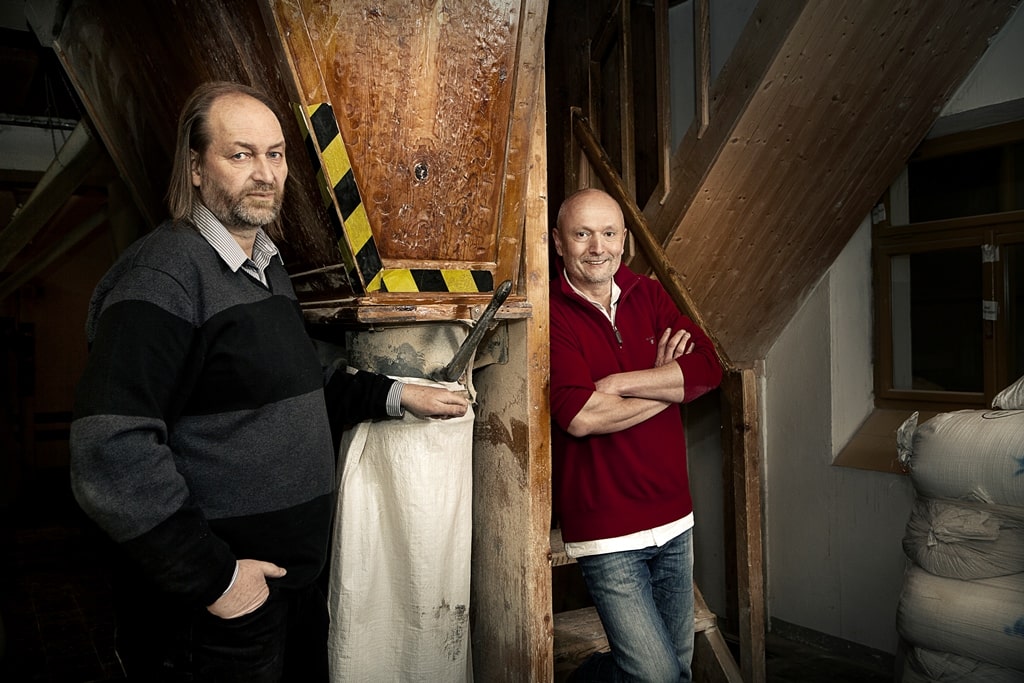
The company PROBIO was founded in the 90s by Ing. Martin Hutař and Ing. Karel Matěj, who decided to focus on the production of organic food. The small company has grown into the largest organic food producer in the Czech Republic with more than 120 employees, three organic mills and its own organic farm.
They focus on traditional crops such as spelt and buckwheat and bring them to modern customers in the form of quality organic food, including gluten-free products produced in a certified mill.
The vision of PROBIO is to promote organic farming and protect the planet for future generations. They are bringing traditional crops back into the menu and linking production with education, for example through excursions and annual Biosavings.
Their combination of ecology, quality and tradition makes them a pioneer of organic food in the Czech Republic.
The exceptionality of traditional crops
Since its establishment, the company PROBIO has focused on the processing of traditional crops that were a common part of Czech agriculture in the past. These crops include, for example, spelt, buckwheat, single or double grain.
These ingredients not only enrich the diet, but thanks to their rich nutritional composition they are real "superfoods".
PROBIO brings these forgotten treasures back into our lives and at the same time supports organic farming, which is kind to nature and preserves healthy soil and water for future generations.
Inspiration for customers
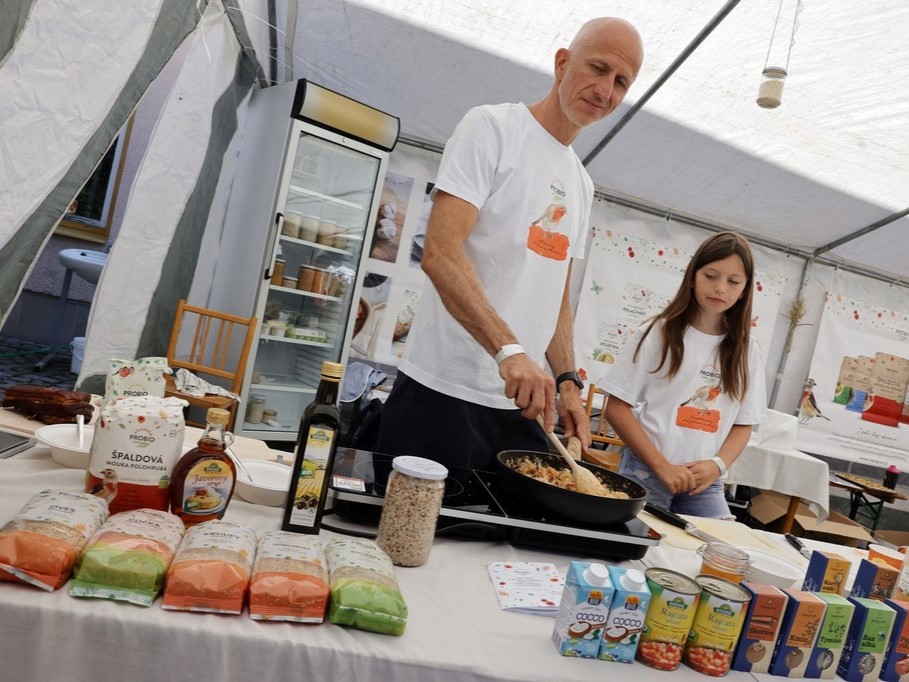
PROBIO brings its customers not only a wide range of organic food, but also new options to enrich their daily diet.
Through original mixes such as barley fritters or buckwheat gingerbread, they introduce customers to lesser-known but nutritious foods. These mixtures are prepared to make it easy and quick to prepare tasty dishes.
PROBIO thus becomes an inspiration for everyone who wants to discover new tastes and at the same time support a healthier and more sustainable way of eating.
From spelt to Czech superfoods
Spelled was one of the first crops that PROBIO returned to the Czech fields, and to this day it is a symbol of their efforts to restore traditional agricultural values.
The experience of our ancestors inspired society to further develop and discover crops that were once a common part of the diet - buckwheat, single or double grain.
These crops, now called 'superfoods', are rich in nutrients and bring not only a variety of flavours but also significant health benefits.
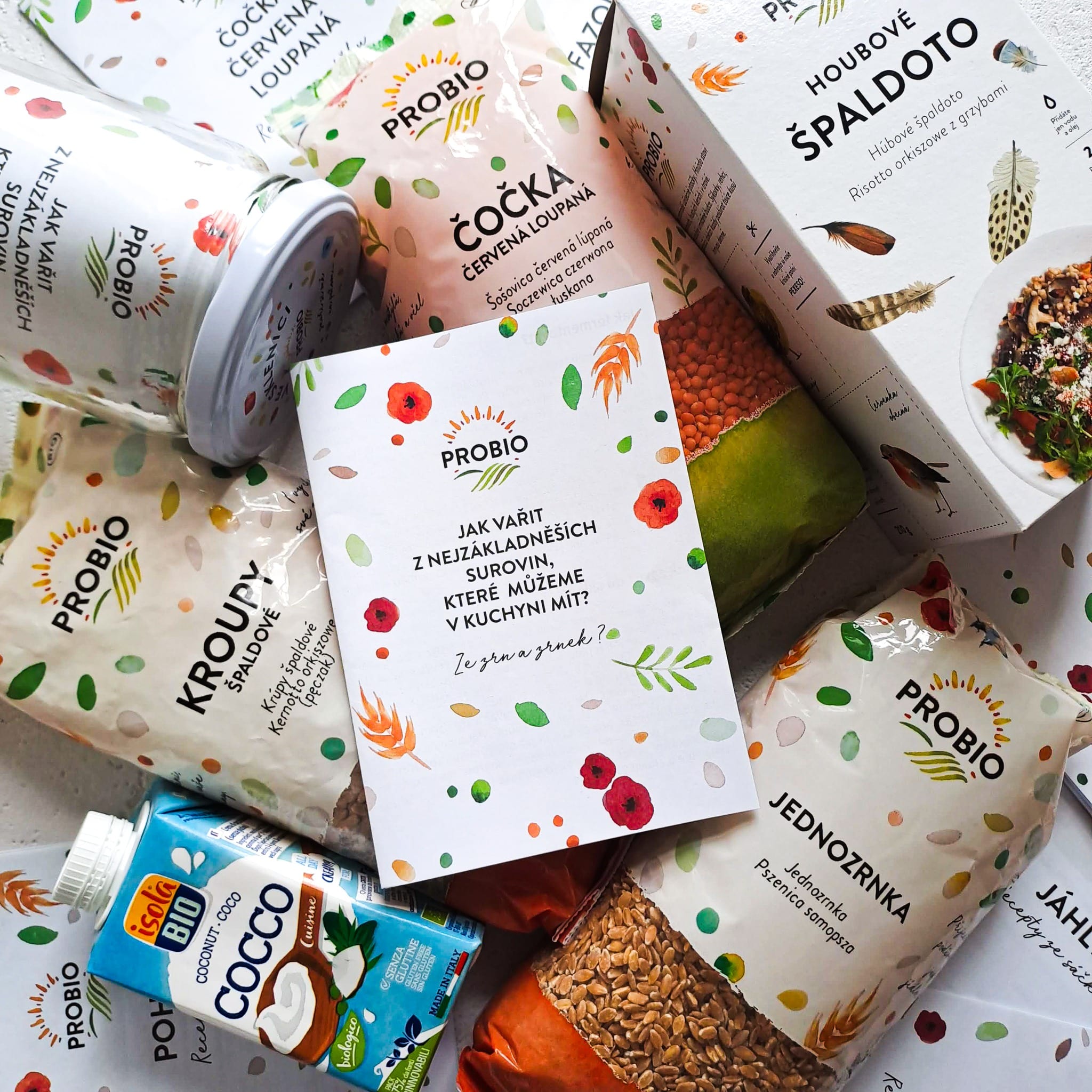
Under the brand PROBIO you will find a whole range of these products, either in the form of basic ingredients or easily prepared mixtures. Each product is associated with a love for the land and respect for nature, which gives Czech superfoods a uniqueness you won't find elsewhere.
PROBIO thus brings traditional values into modern cuisine and inspires a return to a natural way of eating.
Organic farming and sustainability
The company PROBIO is a pioneer of organic farming in the Czech Republic and builds its commitment to sustainability on solid foundations. All of the company's activities are aimed at protecting nature, soil, water and the health of the planet.
He farms on his own organic farm in Hostěrádky, where crops are grown with respect to the natural balance of ecosystems. PROBIO also supports family eco-farms throughout the Czech Republic, from which it takes quality raw materials for the production of its organic food.
The company's certifications confirm its high standards of quality and environmental responsibility. All products carry the organic label and meet strict requirements for organic farming and sustainable production.
In addition, the products from the gluten-free mill are marked with the crossed-out log symbol, which guarantees safety for people with gluten intolerance. The company regularly checks the quality of its products in its own laboratory and ensures that customers receive the best - healthy, clean and environmentally friendly.
PROBIO is thus a symbol of ecological responsibility, which is reflected in every step of their production.

PROBIO - quality organic food
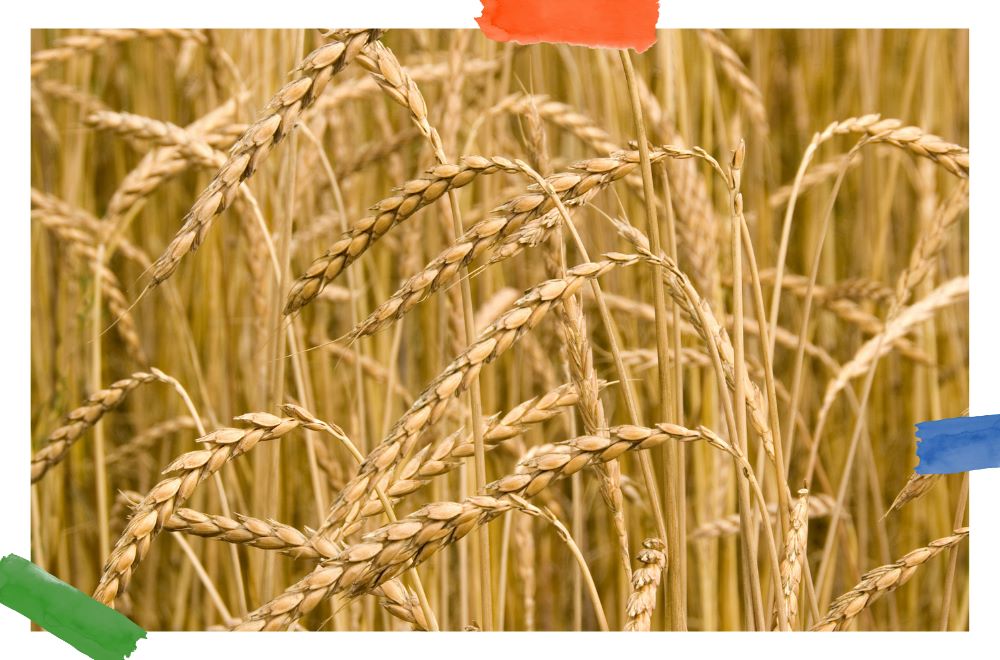
Return of the spelt to the Czech fields
In the 1990s, PROBIO revived the cultivation of spelled, which was almost forgotten at the time.
Thanks to close collaboration with gene banks and our own research, we have been able to reintroduce this cereal and demonstrate its unique properties.
Today, spelt, along with products such as flour and pasta, is the mainstay of their offer.
Support of local farmers
PROBIO actively supports local farmers by purchasing raw materials from family eco-farms throughout the Czech Republic. The company works with farmers who grow crops in accordance with the principles of organic farming, which means they avoid the use of chemical pesticides and fertilizers.
This support not only helps the development of sustainable agriculture, but also strengthens the local economy. PROBIO in this way ensures the high quality of its products and at the same time supports Czech farmers who participate in the cultivation of organic food.
This collaboration contributes to the development of organic farms and landscape protection, which is in line with the brand's philosophy of long-term sustainability and nature conservation.
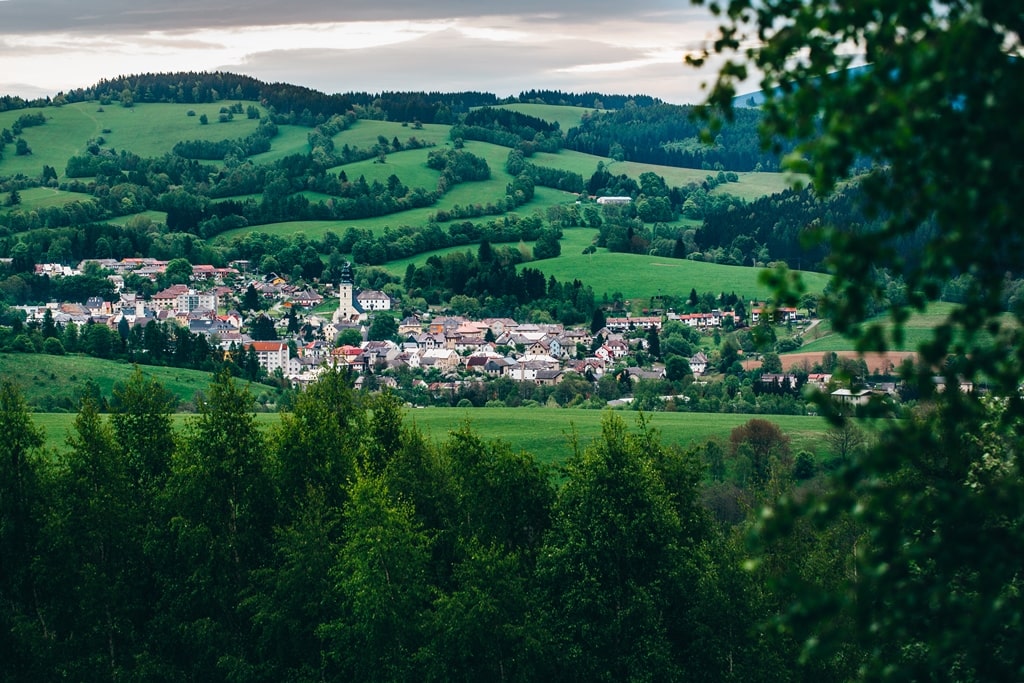
Brand Development PROBIO
A vision for the future
In the future, PROBIO focuses on continuing to support organic farming and expanding its range of organic foods that will meet the needs of modern consumers.
It wants to be a leader in the field of organic food not only in the Czech Republic but also on foreign markets, with an emphasis on quality, sustainability and innovation.
The company also plans to strengthen cooperation with local organic farms and promote sustainable agricultural practices.
Its vision includes educating the public about the environmental benefits of organic food and actively contributing to the protection of nature and the health of the planet, thereby positively influencing the future of organic farming.
The main idea of the company PROBIO is to bring high-quality organic food products that are based on organic farming and respect nature and traditional values.
They focus on sustainability and working with local farmers to promote healthy eating and a responsible approach to the environment.
Who our products are for

People interested in sustainability
Lovers of organic products
Families with children
Vegans and vegetarians
Customers with special dietary requirements
Brand commitments PROBIO

Organic farming
Quality and cleanliness
Sustainability
Transparency
Support of the local economy