
Olive oil and oleic acid: A natural elixir for health, beauty and performance
Olive oil is one of the most well-known and widely respected healthy fats. It sits at the heart of the Mediterranean diet, which is consistently linked to longevity and a lower risk of lifestyle-related disease. Its key active component is oleic acid – an omega-9 fatty acid that supports heart health and skin, and contributes to hormonal balance.
Extra virgin olive oil isn’t just a great ingredient in the kitchen – it can also be an everyday companion in caring for body and mind. If you want to get the most from it, it helps to know how to recognise a quality olive oil, how to store it properly, and what it can bring to day-to-day life.
Contents
How is olive oil made, and why does it matter?
The quality of olive oil starts in the olive grove. What matters is how quickly the olives are processed after harvest, whether the oil is made cold-pressed and without chemicals. The highest grade is extra virgin olive oil – pressed within 24 hours of harvest, at low temperatures, without refining.
Differences between types:
-
Extra virgin olive oil: the purest form, ideal for cold dishes and a morning spoonful on an empty stomach.
-
Virgin olive oil: has slightly higher acidity, well suited to cooking.
-
Refined olive oil: loses valuable compounds, is cheaper, and is used for frying.
-
Blends of olive oils: often contain only a small percentage of high-quality oil.
Even with this classification, we still come across olive oil fraud. You can read more in our article You won’t find good olive oil in a supermarket.
From olive tree to bottle – how olive oil is pressed
Olive harvest
This takes place between October and December, depending on the olive tree variety:
-
By hand – gentle on both the fruit and the trees,
-
Mechanically – faster, but it can damage the fruit or the trees.
Ideally, olives are processed within 24 hours of harvest to avoid fermentation and oxidation.
Cleaning and milling
After harvest, the olives are cleaned of:
-
leaves, twigs, dust,
-
unripe and damaged fruit.
They are then carefully washed with water. Whole olives, including the stones, are crushed into an olive paste – either using stone mills or modern steel crushers.
Malaxation (mixing the paste)
- The paste is mixed for 30–45 minutes at temperatures up to 27 °C – key to producing cold-pressed olive oil (cold-pressed).
Pressing the olive oil
-
Traditional method: hydraulic presses.
-
Modern method: two- or three-phase centrifugation – separates oil, water and pomace (solid residue).
Filtration (optional)
-
The oil is either left to settle or filtered – giving greater clarity and a longer shelf life.
-
Unfiltered olive oil has a more intense flavour, but a shorter shelf life.
Testing and classification
To be labelled as extra virgin olive oil, it must:
-
have acidity up to 0.8 %,
-
pass sensory assessment (no defects, with rich flavour and aroma).
Bottling
-
The oil is filled into dark glass bottles or tins – protecting it from light,
-
nitrogen inerting is often used to prevent oxidation,
-
labels include information on origin, harvest and the best-before date.
And what about so-called "free-run" oil – oil that flows from olives under its own weight?
This luxury product can be found among small producers, but it is highly uneconomical.
What’s more, this method may not extract all phenolic compounds, which can mean its health benefits are lower.
How can you recognise a quality olive oil?
At first glance, you can spot quality olive oil by:
a dark glass bottle (or a tin),
stated acidity up to 0.8 %,
origin and, where relevant, a designation such as PDO (Protected Designation of Origin),
- manufacturer details,
- any awards from international competitions.
The highest quality is listed as extra virgin olive oil (extra virgin), with acidity up to 0.8 %. Producers may use terms such as "luxury" or "prestigious", but these labels are not officially regulated.
How should you store olive oil to keep its qualities?
To maintain quality, we recommend:
storing it in a dark place,
at a temperature between 14–18 °C (for example, a pantry or a cupboard away from appliances),
- once there is only a small amount left in the bottle, it’s worth decanting into a smaller container to avoid unnecessary oxidation,
not storing it in the fridge, as this can change the oil’s sensory characteristics.
Oleic acid – the secret ingredient of health. In other words: what olive oil contains
Olive oil is largely made up of healthy fats and a range of bioactive compounds that can have a positive effect on human health.
Composition of olive oil:
98–99 % fats, mainly:
-
oleic acid – up to 80 % of the total composition,
-
palmitic acid,
-
linoleic acid,
-
alpha-linolenic acid,
-
stearic acid.
0.5–1 % phytochemicals and antioxidants:
-
polyphenols, tocopherols (vitamin E), squalene, sterols, chlorophylls and carotenoids.
Trace compounds and other components:
-
vitamins E and K,
-
iron, potassium (most minerals are in the water phase, which is separated during production),
-
aromatic and flavour compounds,
-
and in unfiltered olive oils, also waxes and pigments.7
You can read more about polyphenols in our article Unique olive oils rich in beneficial polyphenols.
Why is oleic acid so important?
-
This monounsaturated fatty acid has the chemical formula C₁₇H₃₃COOH,
-
supports cell protection,
-
contributes to the health of the vascular system,
-
helps maintain hormonal balance.
How does oleic acid support health?
- Replacing saturated fats in the diet with these unsaturated fats helps maintain normal blood cholesterol levels.
- It may improve blood flow to the brain and have a neuroprotective effect, which may help support cognitive function.
- Extra virgin olive oil with a higher polyphenol content may also contribute to protection against oxidative stress.
- It improves hydration and skin elasticity – helpful for healthy, radiant skin. It also helps active compounds penetrate the skin.1,2,3,4,5,6
How much oleic acid do we need per day?
For an adult, healthy fats should make up roughly 20–35 % of daily energy intake.
Of that, oleic acid – the main component of monounsaturated fatty acids (MUFA) – should account for around 10–20 % of total energy.
Example calculation for an intake of 2000 kcal/day:
-
Total fats: 20–35 % = 44–78 g of fat
-
MUFA (monounsaturated fats): 10–20 % = 200 - 400 kcal
→ approximately 22–44 g of oleic acid
How much is that in olive oil?
-
15 g of extra virgin olive oil (around 1 large tablespoon) contains
70–80 % oleic acid → about 10.5–12 g of omega-9 fatty acids
So to cover the recommended daily intake of oleic acid (MUFA), you only need roughly:
3 tablespoons (around 45 g) of extra virgin olive oil per day.7
3 ways to use olive oil in everyday life
Olive oil isn’t just a standard kitchen ingredient – you can also use it in body care and as part of a healthy lifestyle.
Kitchen – a healthy fat for the whole family
-
Add 1 teaspoon of olive oil to a kid’s soup or porridge.
-
Great in salad dressings, spreads and marinades.
-
Excellent as the base for a post-workout protein bowl.
-
Use it instead of butter on bread.
Extra virgin olive oil is ideal thanks to its high content of oleic acid and antioxidants.
Cosmetics – natural care for mature skin
-
Gentle make-up removal and skin nourishment – it doesn’t leave a greasy film.
-
A olive oil mask for dry, brittle hair.
-
Caring for cuticles and chapped lips.
-
Rich in vitamin E, polyphenols and squalene, which help protect skin from ageing.
A spoonful of oil in the morning on an empty stomach – myth or ritual?
This ritual is growing in popularity, but it won’t suit everyone.
Benefits:
-
Stimulates the gallbladder and supports digestion.
-
Improves absorption of vitamins A, D, E and K.
-
A mild laxative effect, helping with constipation and detoxification.
What to watch out for:
-
Not recommended with gallbladder issues or reflux.
-
Use only quality extra virgin olive oil.
Recommended daily amount:
1 tablespoon (around 10 ml), ideally on an empty stomach or added to food.
Our picks at PravéBio
- ACAIA is a Greek brand that brings together tradition, family heritage and a modern approach to producing extra virgin olive oil. The olives are hand-harvested on the island of Lesbos and cold-pressed within a few hours of picking. Thanks to careful processing, the oil retains a rich aroma, a high polyphenol content and low acidity.
- DAKRY OLIVE offers extra virgin olive oil pressed from hand-harvested Greek olives, within 24 hours of picking. Purity, flavour and honest production – a commitment to customers and to nature.9
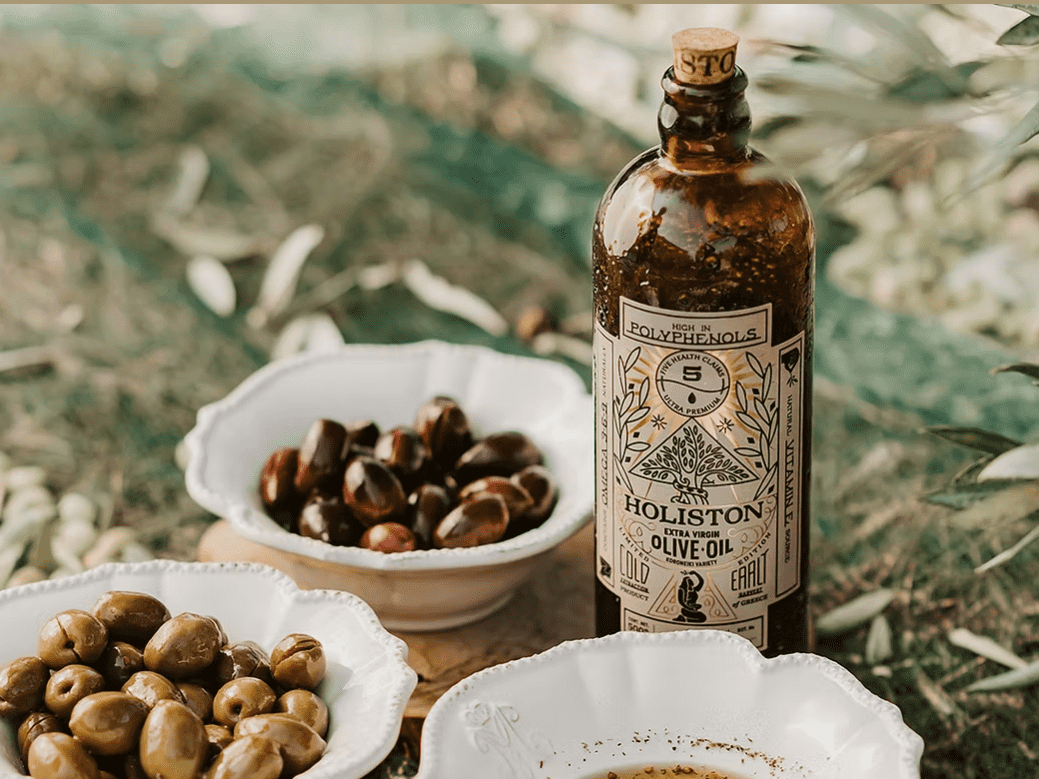
- HOLISTON is a brand focused on premium olive oil quality. Its main aim is to preserve active compounds and deliver maximum health benefits.8
|
ACAIA Extra virgin olive oil from Lesbos - Organic |
DAKRY OLIVE Extra virgin olive oil – Messinia, unfiltered |
HOLISTON Extra virgin olive oil – Rhodes, early harvest |
|
|---|---|---|---|
| Packaging | Dark glass | Dark glass | Dark glass |
| Awards | 30 awards (e.g. Japan Olive Oil Prize) | quality certificate from CHEM SOLUTIONS ANALYTICAL LABORATORIES | TÜV Austria, Olympia Awards |
| Origin | Greece - Lesbos | Greece - Messinia | Greece - Rhodes |
| Filtration | Yes | No | No |
| Variety | Kolovi | Koroneiki | Koroneiki |
Myths and facts about olive oil
Myth: Olive oil isn’t suitable for cooking.
Fact:
Extra virgin olive oil has a smoke point of around 190 °C, which means short cooking or frying at lower temperatures won’t significantly damage it. Unfiltered oil is less stable (around 160 °C).
-
A study states that there is a transfer of bioactive compounds from the oil to the food, and that during gentle frying (180 °C) the biological value of the dish increases.10,11
Myth: Fats are harmful after forty.
Fact:
Healthy fats, such as those found in olive oil, are essential for:
-
hormonal balance,
-
proper brain function,
-
skin health.
Recommended fat intake for adults is 20–35 % of daily energy intake.
They also help with the absorption of vitamins A, D, E and K.
Olive oil is a rich source of oleic acid, which protects your blood vessels, skin and brain function. It works in the kitchen, in cosmetics, and as a morning cleansing ritual. Just 2–3 tablespoons a day and your body will thank you – fewer inflammations, more energy and more supple skin. Thanks to its simple composition, it’s also appropriate for kids, breastfeeding women and athletes. Start your day with a spoonful of olive oil on an empty stomach or add it to a smoothie – you may grow to love this healthy habit.
Did you find the article useful? Share it with your friends using the button below. If you don’t want to miss more interesting updates, subscribe to our news and follow us on social media.
Under EU regulations, we can’t link from the blog directly to web pages featuring a promoted product. You can, of course, find the products on our website Pravé Bio.
Sources
- Effect of olive oil consumption on cardiovascular disease, cancer, type 2 diabetes, and all-cause mortality: A systematic review and meta-analysis. 2022. Clinical Nutrition Journal. Online. Available here.
- Is There More to Olive Oil than Healthy Lipids? 2023. Nutrients. Online. Available here.
- Health Outcomes Associated with Olive Oil Intake: An Umbrella Review of Meta-Analyses. 2024. Foods. Online. Available here.
- Formulation and Evaluation of Chironji-Derived Oleic Acid-Based Herbal Sunscreen for Enhanced Photoprotection. 2025. International Journal for Research in Applied Science & Engineering Technology. Online. Available here.
- Effect of Enhancers on in vitro and in vivo Skin Permeation and Deposition of S-Methyl--Methionine. 2017. Biomolecules & Therapeutics. Online. Available here.
- Exploring Olive Pomace for Skincare Applications: A Review. 2023. Cosmetics. Online. Available here.
- Protective effects of oleic acid and polyphenols in extra virgin olive oil on cardiovascular diseases. 2024. Food Science and Human Wellness. Online. Available here.
- Holiston official website. Available here.
- Dakry Oli official website. Available here.
- Oxidative Stability and Changes in Chemical Composition of Extra Virgin Olive Oils After Short-Term Deep-Frying of French Fries. 2015. Journal of the American Oil Chemists Socieety. Online. Available here.
- Evolution of the metabolic profile of virgin olive oil during deep-frying: Assessing the transfer of bioactive compounds to the fried food. 2022. Food Chemistry. Online. Available here.
ŠárkaShe has devoted her education and professional life to the worlds of gastronomy and nutrition. After studying hospitality and human nutrition, she completed her training with a qualification as a nutritional therapist, giving her a rounded view of how food and health connect.
She now uses this knowledge mainly in caring for her kids.
She isn’t afraid of challenges and opportunities, believes in new beginnings, and values a sustainable lifestyle. Outside of her profession, she enjoys gardening, hiking, and above all her family, which remains her strongest anchor in life.