
Grass-fed Beef Bone Marrow beef bone marrow • grass-fed origin • simple ingredients • buttery taste • easy portioning • culinary versatility • 180 g
Grass-fed beef bone marrow is a traditional animal-derived ingredient for hot dishes. It has a rich, gently buttery flavour with pronounced umami notes.
The jar contains 180 g of marrow, allowing you to take only the amount you need without roasting marrow bones or scooping out the marrow. Once opened, keep refrigerated, close carefully and ideally use within four weeks.
Why we added Modern Native to the PraveBio.cz range
Modern Native is a Dutch brand of food supplements and traditional animal-derived ingredients. It grew from founder Jeroen van Straaten’s personal experience with strength training, a limited diet and a return to foods traditionally used by cultures following a nose-to-tail approach.
The brand works with organs and animal-derived ingredients from traceable farms, uses glass packaging and avoids fillers, sweeteners and unnecessary additives. It is not certified organic; its main strengths are traceable sourcing, gentle processing and simple formulas that remain close to the original ingredient.


Grass-fed beef bone marrow – a traditional cooking fat in a jar
Modern Native beef bone marrow is a single-ingredient animal-derived food from grass-fed Irish cattle. It softens with gentle heat and mixes easily into a finished dish. The 180 g jar provides approximately 36 servings of 5 g.
- For: households that use traditional animal fats when preparing meat, sauces, broths and vegetables.
- Characteristics: 100% beef bone marrow with a rich, gently buttery flavour and pronounced umami notes.
- Animal-derived fat: According to the label, the bone marrow contains 86.2 g of fat per 100 g. It softens with gentle heat and mixes easily into meat, sauces, broths or vegetables.
- Free from: added vegetable oils, salt, sugar, preservatives, flavourings, sweeteners and soya. Check the current label for information on gluten and possible cross-contamination.
- Serving: approximately one teaspoon, or around 5 g, per serving of finished food; once opened, ideally use within four weeks.
Add the marrow mainly towards the end of cooking. Let it melt over a cooked steak, stir it into pan juices, sauce or broth, or use it to finish roasted vegetables. For high-temperature searing, a more heat-stable fat such as ghee or beef tallow is more appropriate.
Unlike marrow bones, there is no need to roast the bones, scoop out the marrow or handle the remaining bones. When using one approximately five-gram teaspoon for each of two servings four times a week, one jar lasts for around four weeks. Once opened, keep refrigerated, close carefully and use a clean spoon to serve.
Related articles
Suitable for
Pravé Bio recommends alongside it
- Real Salt® finely ground sea salt in a shaker (Redmond)
This unrefined salt brings out the flavour of meat, eggs, pan juices and roasted vegetables while complementing the marrow’s buttery notes. - Extra virgin avocado oil (Hunter & Gather)
A cold-pressed oil with a mild flavour for cold and hot dishes where a more neutral fat is preferred. - Organic Sensitive bone broth powder (Planet Paleo)
A broth base for soups, sauces and meat juices. Stirring in a teaspoon of marrow at the end of cooking softens the texture and deepens the flavour. - Organic coconut toddy vinegar (Ceylon Kokonati)
The acidity balances the richness of animal fat in sauces, meat juices and dressings.
Bone marrow fills the cavities inside bones. Its structure and composition differ from muscle meat and subcutaneous fat; the proportion of its individual components varies naturally according to the animal’s age, anatomical location and processing.
Food descriptions should therefore reflect the properties of the specific ingredient and documented analytical values. Naturally occurring substances should not be given separate health effects without appropriate evidence.
Sources for scientific context: PubMed PMID 22456051 and PubMed PMID 22055146.
Beef bone marrow – key benefits
- Ready-to-use bone marrow in a jar – no need to roast marrow bones, scoop out the marrow or handle the remaining bones.
- 100% animal-derived ingredient – the formula contains only beef bone marrow, without seasonings or processing additives.
- Grass-fed cattle – the ingredient comes from grass-fed Irish cattle.
- Rich, buttery flavour – even a small amount enhances steak, roasted vegetables, potatoes, pan juices or sauces.
- Traditional animal-derived food – marrow comes from inside the bones and allows more of the animal to be used in the kitchen.
- Naturally high in fat – according to the label, it contains 86.2 g of fat per 100 g, giving it its soft texture and rich flavour.
- No added vegetable oils – a single-ingredient option without added vegetable fats.
- Versatile use – suited to finishing meat, broths, sauces, roasted vegetables and warm bread.
- Practical glass jar – allows clean serving, resealing and the use of only the amount needed.
- Measured by the teaspoon – use a small amount to finish a dish without preparing a whole bone.
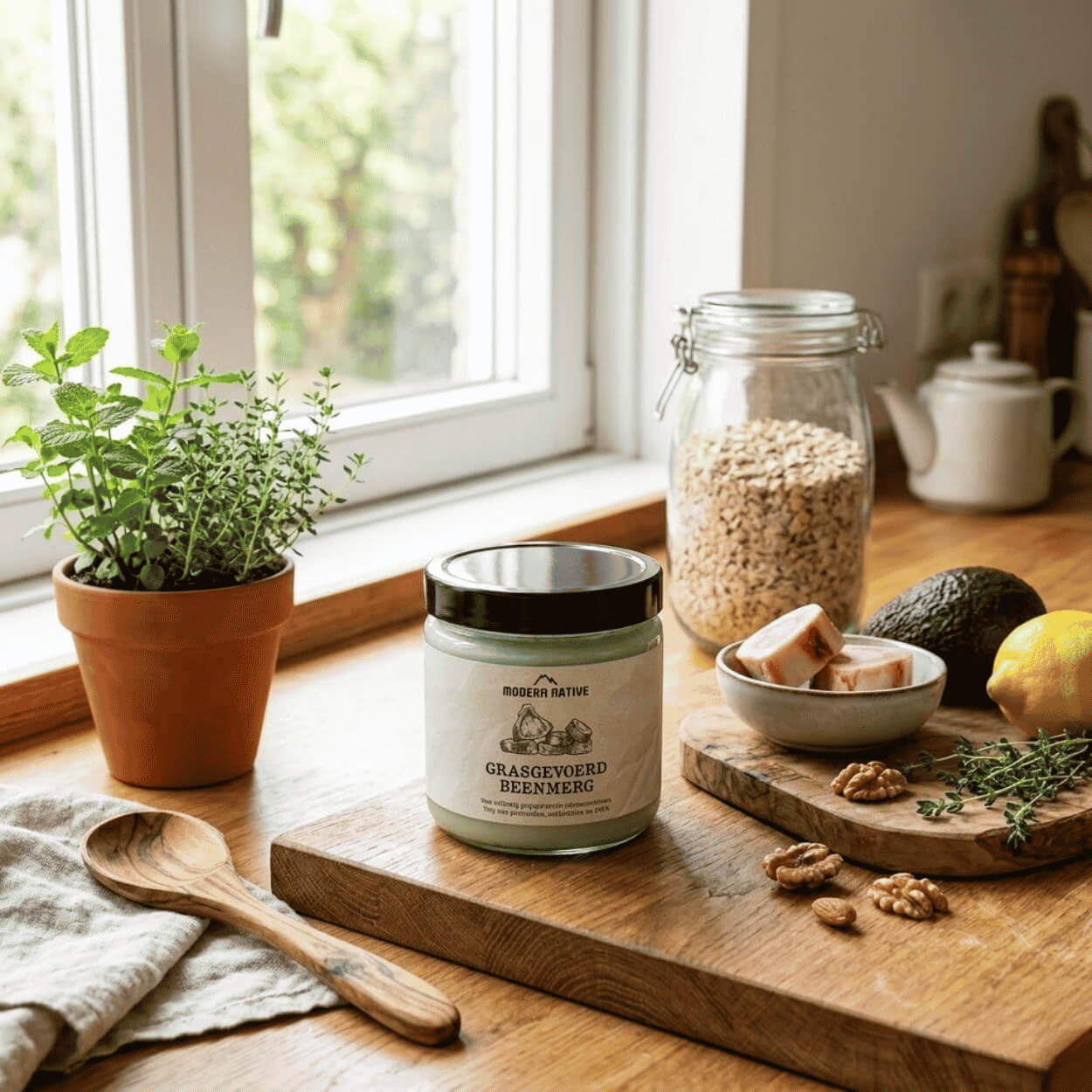
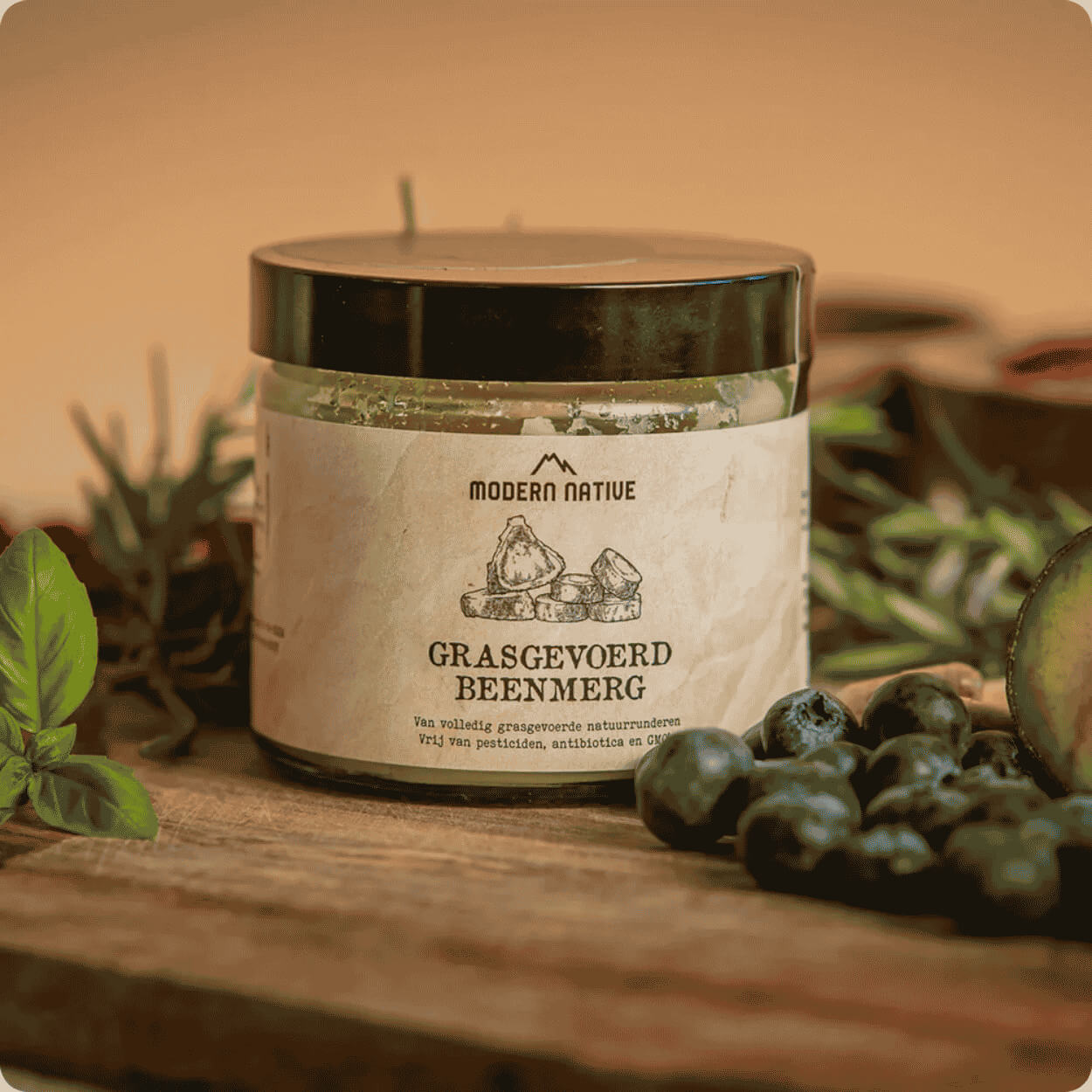
The glass jar protects the prepared bone marrow and makes precise teaspoon servings easier.
Which Modern Native product should you choose?
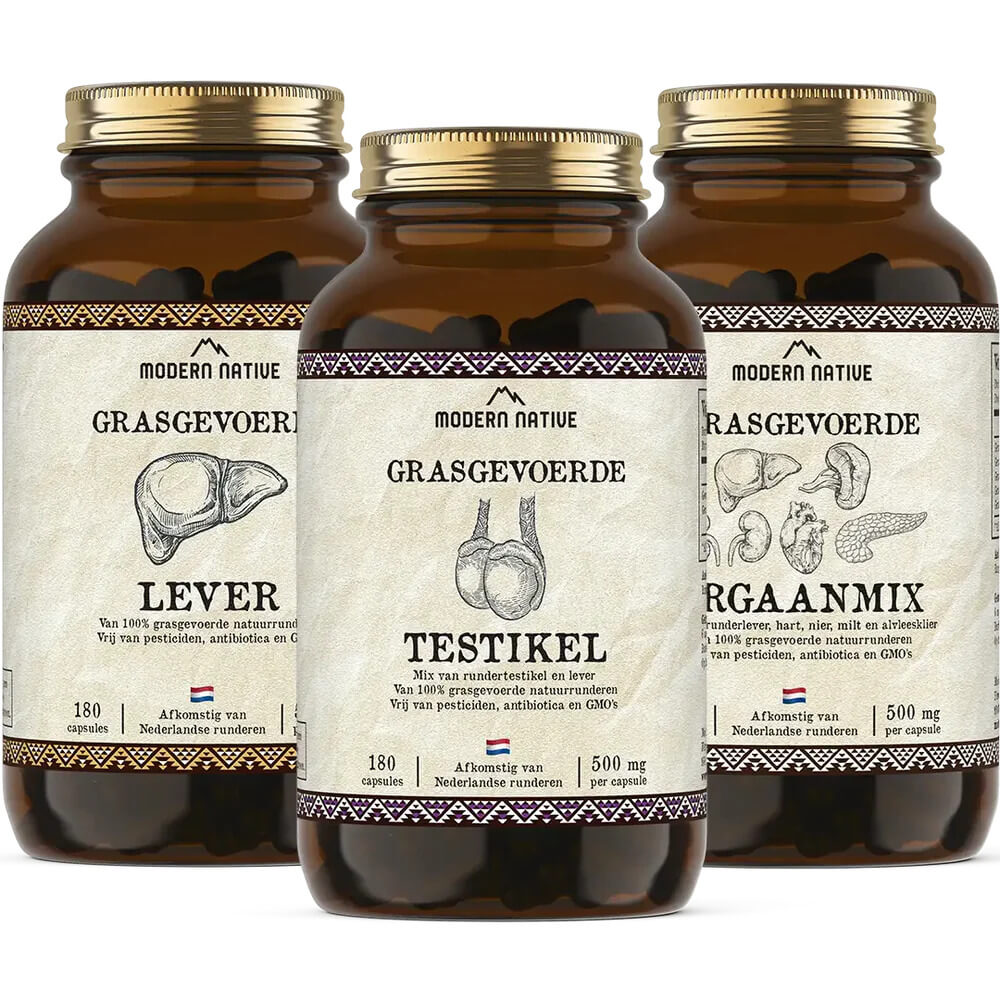
The Modern Native range includes individual organs, multi-organ blends and fermented animal-derived supplements. The options differ in the type of tissue, processing method and breadth of the formula.
Individual organs in capsules contain one specific type of tissue. Beef liver, heart, kidney and bull glands differ in their composition, so the information on the label is what matters.
Multi-organ blends combine several types of animal tissue in a precisely defined ratio. Compared with single-ingredient capsules, they include a broader range of raw materials.
Specialised organ supplements combine selected tissues in a specific ratio. The bull gland and liver blend contains no herbs, sweeteners or isolated minerals.
An example of a fermented animal-derived supplement is kefir processed into capsules. It differs from organ supplements through its dairy ingredient and fermentation process.
Why choose Modern Native
Brand origins: Modern Native was founded in the Netherlands in response to a simple issue: organ meat has traditionally formed part of the diet, but most people no longer prepare it regularly. Founder Jeroen van Straaten became interested in organs after his experience with strength training, a limited diet and a search for nutrition that did not rely on anonymous blends.
Nose-to-tail principle: The brand follows the view that a well-raised animal should not be reduced to muscle meat alone. Organs have traditionally formed part of using the whole animal, and Modern Native presents them in a precisely measured, easy-to-store format that is also straightforward for customers who do not want to prepare organs in the kitchen.
Relationships with Dutch farms: The ingredients come from grass-fed cattle in the Netherlands. The brand works with local partners, including Zorg & Natuur, Vlees van Ons and Reestdal Rund. A shorter supply chain supports traceability, the freshness of the raw material and less reliance on anonymous, high-volume sources.
Gentle processing: The organs are freeze-dried, ground into powder and filled into bovine gelatine capsules. The brand avoids fillers, flavourings and plant-based capsules that would unnecessarily alter the animal-derived character of the supplement. The result is a simple formula that is clear from the label.
Glass instead of plastic: Modern Native uses glass jars, limiting contact between the capsules and plastic while protecting the contents from light. This detail reflects the brand’s approach: practical decisions that affect storage quality rather than bold promises.
Who the brand is not for: Modern Native is neither vegan nor certified organic. It is for customers who prefer whole animal-derived ingredients, traceable sourcing and concise formulas over sweet powders, flavoured blends or long lists of additives.

Traceable ingredient sourcing
The brand works with identified sources of animal-derived ingredients rather than relying on anonymous origins without further context.
Nose-to-tail principle
Modern Native uses parts of the animal with a long history in traditional cooking that are often missing from modern diets.
Simple formulas
The range mainly contains single-ingredient or concise formulas without sweeteners, flavourings or unnecessary processing additives.
Glass packaging
Glass jars protect the contents, limit contact between the ingredient and plastic, and reflect the brand’s calm, functional approach.
Gentle processing
The brand freeze-dries its organ supplements and processes its animal-derived foods without unnecessary additives.
Independent testing
The brand has its food supplements tested for purity, an important selection criterion for animal-derived ingredients.
Ingredients
100% beef bone marrow from grass-fed cattle. The ingredient comes from Irish cattle. The product contains no added vegetable oils, salt, sugar, spices, flavourings, preservatives or other processing additives.
Nutritional values
| Typical values | per 100 g | per 5 g (approximate serving) | What this means in a 5 g serving |
|---|---|---|---|
| Energy | 784 kcal | 39.2 kcal | Bone marrow is an energy-dense food, so a small amount is generally enough to finish one serving. |
| Fat | 86.2 g | 4.31 g | Fat is the product’s main nutritional component and gives the marrow its characteristic richness, soft texture and ability to melt into warm food. |
| of which saturates | 14.9 g | 0.75 g | An approximate five-gram serving contains less than 1 g of saturated fat. |
| Carbohydrate | 0 g | 0 g | According to the label, the product contains no carbohydrate. |
| of which sugars | 0 g | 0 g | No sugar is added, and the label declares 0 g of sugars. |
| Protein | 1.7 g | 0.09 g | Protein is present only in a small amount; bone marrow is not a source of protein. |
| Salt | 0 g | 0 g | The product is unsalted. Adjust the seasoning separately to suit the dish. |
Values per 100 g are based on the information shown on the label. Values per 5 g are an approximate mathematical calculation for one teaspoon. The jar contains 180 g, or approximately 36 servings of 5 g. As a result of rounding, actual values in a small serving may differ slightly.
Ingredient breakdown
Beef bone marrow
What it is: Soft animal tissue taken from the inner cavities of beef bones. It makes up 100% of the product.
Function: Bone marrow is not simply a carrier or additive. It is the only ingredient and determines the flavour, texture and nutritional profile of the entire product.
Benefits: It provides ready-to-use marrow without roasting marrow bones, scooping out their contents or handling the remaining bones.
Natural fat content
What it is: According to the label, the bone marrow contains 86.2 g of fat per 100 g, of which 14.9 g is saturated fat.
Function: The fat creates the characteristic soft, buttery texture and melts easily into pan juices, sauces or finished dishes with gentle heat.
Benefits: A single teaspoon can give a dish a richer flavour and smoother texture without the need for a large amount.
No added oils or flavourings
What it is: A single-ingredient formula without added vegetable oils, salt, sugar, spices, flavourings or preservatives.
Function: The product is not bulked out with a cheaper fat or altered with flavouring or processing additives.
Benefits: The customer receives an ingredient with a clear origin and can adjust the salt, spices and overall intensity of flavour to suit the dish.
What does this mean?
Modern Native beef bone marrow is a ready-to-use traditional animal-derived food, not a food supplement or a blend of several fats. The entire jar contains beef bone marrow from grass-fed cattle. It is primarily for finishing meat, broths, sauces, pan juices, roasted vegetables or warm bread.
Marrow is naturally high in fat and low in protein. Based on the label, it should not be presented as a source of protein, vitamins or minerals. Its main practical value lies in its pronounced flavour, soft texture and the ability to use a precise amount without preparing whole marrow bones.
Use in the kitchen
As a general serving, use 1 teaspoon, or approximately 5 g, per serving of finished food. Adjust the amount to suit the desired intensity.
- Meat: let a small amount of marrow melt over a cooked steak, burger, roast beef or lamb.
- Sauces and pan juices: stir it in after removing the pan from intense heat to soften the texture and deepen the flavour.
- Broths and soups: add it at the end of cooking and stir thoroughly.
- Roasted vegetables: mix a small amount into warm potatoes, carrots, cauliflower or squash.
- Bread: spread a thin layer over warm sourdough bread and season with salt or herbs.
- Serving: because of its high fat and energy content, use marrow as a finishing ingredient rather than the main fat in a large serving.
Storage: Store the unopened jar according to the instructions on the packaging. Once opened, keep refrigerated, close the jar carefully, use a clean spoon and ideally consume within four weeks.
Warnings
- This is not a food supplement or medicine.
- People with dietary restrictions, impaired fat digestion or a medically prescribed diet should consult a doctor or registered dietitian.
- Store the unopened jar according to the instructions on the packaging.
FAQ
What is beef bone marrow and how is it used?
Beef bone marrow is soft, fatty tissue from the inner cavities of bones. In the kitchen, use a small amount to finish meat, sauces, broths, vegetables or bread, adding a richer, gently buttery flavour.

What are the exact ingredients?
The product contains only 100% beef bone marrow from grass-fed cattle. The ingredient list contains no vegetable oils, salt, sugar, spices, flavourings or preservatives.
Where does the bone marrow come from, and what does grass-fed mean?
According to the label, the ingredient comes from grass-fed Irish cattle. The term grass-fed describes how the animals were fed; it does not in itself mean certified organic or automatically confirm other farming standards.
Is the bone marrow certified organic?
The label does not show organic certification or the corresponding organic logo. The product should therefore not be described as organic; the stated information covers grass-fed cattle and the Irish origin of the ingredient.
How is the bone marrow processed?
The producer states that the marrow is removed from the bones, gently heated and then filled into jars. The result is a ready-to-use ingredient that does not need to be roasted inside the bones or laboriously scooped out.
What does bone marrow taste and smell like?
The flavour is rich, gently buttery and meaty, with umami notes. The aroma should be clean and naturally animal-derived, rather than sharp, sour or rancid.
What is the difference between bone marrow in a jar and marrow bones?
The contents of the jar have already been separated from the bones and are ready for direct use in the kitchen. There is no need to buy and roast marrow bones, scoop out the marrow or handle the remaining bones, and it is easy to take only a small amount.
How does bone marrow differ from beef tallow, butter, ghee or lard?
They differ in their origin, flavour and texture. Bone marrow comes from inside bones and has a more pronounced meaty character; beef tallow and lard come from fatty tissue, while butter and ghee are dairy fats. They are therefore not identical ingredients.
Can bone marrow be eaten directly or cold?
Yes, it is a ready-to-eat food. It is firmer and more pronounced in flavour when cold; gentle heating softens it, makes it easier to spread and helps it mix into a dish.
How do you use bone marrow in the kitchen?
Let a small amount melt over a cooked steak, stir it into pan juices, sauce, soup or mashed potatoes, or spread it over warm bread. Start with a smaller amount and add more to taste.
Which dishes work best with bone marrow?
It works well with beef and lamb, burgers, broths, reduced sauces, roasted potatoes, root vegetables, cauliflower, squash, risotto or warm sourdough bread.
Can you fry or roast with bone marrow?
The producer also lists it for cooking. To retain its characteristic flavour, work at a low to medium temperature or add it towards the end of preparation. Do not allow the fat to overheat or smoke.
How much bone marrow should you use per serving?
A practical starting point is approximately 1 teaspoon, or around 5 g. This amount provides approximately 164 kJ / 39 kcal and can be adjusted according to the recipe, taste and overall diet.
Can you eat bone marrow every day?
As an ordinary food, it can be included according to personal preference, but there is no established recommended daily serving. It contains 86.2 g of fat per 100 g, so consider your overall energy and fat intake.
How should an unopened jar be stored?
Follow the storage conditions and best-before date on the label of the specific batch. The producer recommends refrigeration to retain quality for as long as possible.
How should bone marrow be stored once opened?
Once opened, keep it refrigerated, close the jar carefully after each use and serve with a clean, dry spoon. Limit the time it remains open at room temperature.
How long does bone marrow keep once opened?
The date on the packaging, storage conditions and the state of the specific batch are what matter. The producer’s current product page does not state a separate guaranteed period after opening, so a fixed timeframe should not be promised. Do not consume the product if its smell, flavour or appearance changes.
Can the jar be kept outside the fridge briefly or taken on a journey?
The producer currently gives an approximate shelf life of around three months outside the fridge while also recommending refrigeration. Always follow the conditions and date on the label of the specific batch; once opened, do not leave the product in warmth, direct sunlight or a car for extended periods.
Why is bone marrow firm in the fridge and softer when warm?
This is a natural property of animal fat. It solidifies at lower temperatures and softens or melts when heated. A change in physical state alone does not indicate spoilage if the smell, colour and flavour remain normal.
Is variation in colour or texture between batches natural?
Yes. With a single animal-derived ingredient, the shade, firmness and smoothness may vary naturally according to the raw material and temperature. Pronounced greying, unusual marks or an unpleasant smell are not normal characteristics.
How can you recognise spoiled or rancid bone marrow?
Warning signs include a sharp, musty, sour or rancid smell, an unpleasantly bitter taste, visible contamination, mould or an unusual change in colour. If in doubt, do not taste the contents and discard the product.
Does bone marrow contain gluten, milk, lactose, soya or other allergens?
The declared ingredient is beef bone marrow only, with no cereals, milk or soya listed. For allergies, coeliac disease or another medically necessary elimination diet, always follow the complete labelling of the specific batch and any information on possible cross-contamination.
Does bone marrow suit keto, low-carb, carnivore, paleo, vegetarian or vegan diets?
According to the label, it contains 0 g of carbohydrate per 100 g and is entirely animal-derived, so it may fit some versions of keto, low-carb, carnivore or paleo eating. It is not appropriate for vegetarian or vegan diets.
Is bone marrow suitable for kids?
In a small, ordinary culinary amount, it can form part of a family meal. For very young kids, difficulties tolerating fatty foods, allergies or a therapeutic diet, discuss its inclusion with a paediatrician or registered dietitian.
Can pregnant or breastfeeding women and people on a special diet eat bone marrow?
The label does not state any specific restrictions for pregnant or breastfeeding women. Individual restrictions may relate to a medically prescribed diet or tolerance of fatty foods; in these cases, consult a doctor or registered dietitian.
How many calories does bone marrow contain, and what are its nutritional values?
Per 100 g, it contains approximately 3280 kJ / 784 kcal, 86.2 g of fat, of which 14.9 g is saturated fat, 0 g of carbohydrate, 0 g of sugars, 1.7 g of protein and 0 g of salt. A five-gram teaspoon provides approximately 164 kJ / 39 kcal.
Is bone marrow a source of protein, collagen, vitamins or minerals?
The label declares only 1.7 g of protein per 100 g, so it cannot be presented as a source of protein. The producer mentions the natural presence of collagen and certain other substances, but their amounts have not been analytically established on the label; claims about significant levels or related effects therefore cannot be made.
Can bone marrow be linked to joints, skin, immunity, energy or blood formation?
These terms appear in online searches relating to bone marrow and collagen, but search interest alone is not evidence of an effect. Without analytically documented amounts of specific nutrients, bone marrow cannot be said to support joints, skin, immunity, energy or blood formation, and it should not be presented as a way to address health problems.
How does bone marrow relate to sustainability and using the whole animal?
Using marrow follows the culinary nose-to-tail principle because it makes use of a part of the animal that is not usually eaten as muscle meat. Once completely empty and cleaned, the glass jar can be recycled according to local rules; without a documented assessment, however, the product should not be claimed to have a lower environmental footprint.
Why is prepared bone marrow more expensive than ordinary fat, and what is its practical value?
The marrow must be removed from inside the bones, separated, processed and filled into jars. Its practical value lies mainly in its single-ingredient composition, declared Irish origin and immediate use without roasting and cleaning marrow bones; a higher price does not in itself mean that it is healthier than other fats.
Additional parameters
| Category: | Cooking oils & fats |
|---|---|
| EAN: | 8720589464520 |
| Best Before: | 17.02.2026 |
| Suitable for: | gluten fee-sugar free-soy free-low carb-keto-paleo |
| Why buy: | A Dutch company dedicated to crafting premium-quality dietary supplements from concentrated and freeze‑dried organs. Their products harness the ancestral wisdom of whole‑food nutrition and bring it into the modern world — to support your vitality, balance, and long‑term health in the most natural way possible. |
| Manufactured by: | Modern Native B.V. Flevolaan 10, 9501 VG, Stadskanaal, The Netherlands |
| Country of origin: | Netherlands |
Product rating
Be the first who will post an article to this item!
Discussion
Be the first who will post an article to this item!

Our ancestors lived differently from us. Traditional societies have been eating organ meat for centuries. They did it for a reason. Intuitively, they knew it was good for them. They knew that organ meats were the source of the most important nutrients. Similarly, in nature many predators go after organ meat first and muscle meat second.
We hardly eat organs these days. It's an ancient tradition that has faded away. Modern Native's mission is to bring the wisdom of our ancestors back to the modern world for optimal health, strength and happiness.
There is no organ meat like meat
Not all organs are the same. When looking for quality (organ) meat, it is important to check several points:
- 100% grass-fed cattle
- Without hormones
- Pesticide and GMO free
- Animals live stress-free and completely in the wild
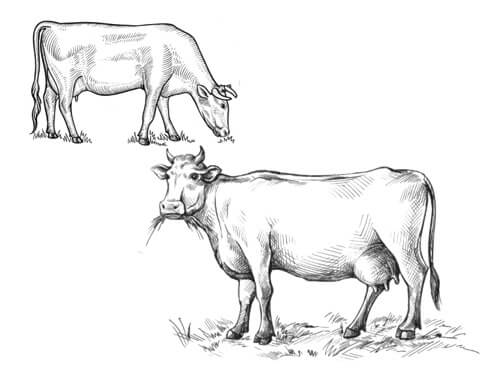
The term "grass-fed" doesn't tell the whole story. The cow may be partially outside in the summer eating fresh grass, while most of the time she is in the barn and fed concentrate. 100% grass-fed, that's the Modern Native way of doing things. They only work with farmers whose cattle meet the above points. The organs are obtained from cattle in the Netherlands.
Why local cattle?
- It maintains the health of local natural farmers and creates jobs in the industry, thus creating more natural farmers in the Netherlands.
- Where there is more demand, there will be more supply. This will eventually allow the price of quality meat, including organ meat, to fall.
- More local natural farmers means fewer traditional herds (mass production) and happier cattle.
- Money spent on local farms stays in the economy, which has a domino effect and creates more jobs.
- Shorter distribution chains reduce unnecessary transport.
- When there are more natural livestock, healthier soil is created.
- Naturally grazing cattle return nutrients to the soil through the urine and manure they excrete.
Method for Modern Native accessories
- It comes from 100% grass-fed cattle.
- No hormones.
- Pesticide and GMO free.
- The animals live stress-free and completely in the wild.
Why eat organ meat?
Beloved by our ancestors
Traditional peoples, Native Americans, and ancient ancestors believed that consuming the organs of a healthy animal would promote the health of the individual's organ. They ate "from head to tail", i.e. everything from the animal, because they intuitively knew how nutritionally rich the meat from the organs was.